Showing posts with label nutrition. Show all posts

February 24, 2015

Bone Broth Days

Sleet, snow, ice and freezing temperatures last week were all good reasons to stay inside and close to one of the woodstoves. When the weather forecast called for our first real winter storm of the season, I decided it was time to make my annual supply of bone broth.

Monday
Low 27° F / -18° C
High 35° F / 2° C
0.5 inches of sleet and freezing rain

Only a quarter inch coating of ice on the tree branches, not bad

Dig through the freezers for the the various bags of bones I popped in over the year. These are set in bowls in the chilly pantry to defrost.

Treks outside to fill hay feeders and top off water buckets with hot water are frequent, but having that good wood heat to come back to is a comfort.

Tuesday
Low 31° F / 0° C
High 35° F / 2° C
Ice begins to melt but refreezes again

Frozen sleet encrusted the ground, bushes, and trees, but not the goats

Begin soaking defrosted bones in mild vinegar water (1 tablespoon apple cider vinegar per half gallon of water) to dissolve the minerals. The long soak followed by two days of simmering extracts calcium, collagen, magnesium, phosphorus, silicon, sulphur, chondroitin sulphates, and glucosamine from the bones.

This is the first year I've had chicken feet to add to my broth. These are rich in glucosamine chondroitin, collagen and other trace minerals.

Chicken feet, scrubbed, declawed, & set to simmer before peeling

Wednesday
Low 22° F / -5° C
High 37° F / 3° C

Coffee, more toast, & a pot of bone broth

Day one of simmering.

Shards of ice break free from tree branches and sprinkle down everywhere.

Thursday
Low 13° F / -10° C
High 28° F / -2° C

Day two of simmering.

In one of my frequent critter checks I find Surprise shivering from the cold and have to do something. First make-do goat coat was a towel secured with grosgrain ribbons. That didn't last. Second coat was made from an old sweat shirt worked better.

Surprise in her goat coat.

Keeping water from freezing is a concern, but since this kind of weather is the exception for us, rather than the norm, I can't justify buying electric water bucket heaters and stringing power cords all over the property. We make frequent hot water trips instead. This helps ...
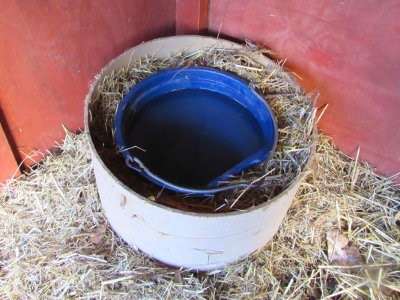
Insulating the water bucket with manure and straw

The composting action of the manure and straw produces heat. Overnight, ice in all other buckets was too thick to break by morning, but this bucket was just starting to form ice on the water surface.

Friday
Low 10° F / -11° C
High 35° F / 2° C

Strain broth, set in fridge to cool.

Warmer temperatures are predicted over the weekend and the ice has slowly been melting. Actual damage from the ice and wind hasn't been too bad, with only nominal damage to the fence.

It was fortunate only the top of the tree landed on the fence.

Saturday
Low 29° F / -1° C
High 40° F / 4° C
0.55" of wintry mix

Skim the chicken fat from the stock but there isn't much. A good bone broth will be congealed when it's chilled.

Looks to be a good batch. I'll add salt to each jar I can.

Bring the broth to a boil for canning. Get the canner, clean jars, and lids ready. While everything is heating, pick the meat from the cooled bones.

Can the broth. I like pints the best because it's just the two of us. I use them for soups, stews, gravies, and cooking grains or beans.

Open a quart of home canned chicken and make a homestead chicken pie for dinner, adding the meat bits. If there had been enough chicken fat, I would have used it to make the biscuits, but there wasn't.

Yield: 15 pints

A few mild days and nights bring some relief, but they're calling for snow tonight and tomorrow. I hope all of you are staying safe and warm.

May 29, 2012

Kris's Turn. Poor Kris

Kris, who has perfected the "poor puppy" look. :)

We've had a poor Jasmine post. Now we have a poor Kris post. Fortunately he has not broken his leg (or anything else), but he did start limping, which alarmed us. Upon taking a closer look, we discovered that his elbow was enlarged. He got to where he would lay around most of the day, not moving much and looking forlorn (a look he has perfected, BTW). Diagnosis? Probable elbow dysplasia.

Kris, 5 month, & Kody, 4 months

I say probable, because even though elbow and especially hip dysplasia are common in large breed dogs, and even though symptoms can be seen in puppies as young as 4 to 10 months, a true diagnosis can't be made until the dog is 24 months old, according to the Orthopedic Foundation for Animals. X-rays are commonly used to diagnose, also cat scans. Treatment is surgery and anti-inflammatory drugs. Arthritis always sets in, apparently even with surgery.  Rather devastating news for a puppy barely 5 months old.

I still have to get my photos from the other side of the fence
Otherwise I'm mobbed by wiggles and puppy kisses

Heredity and diet are considered key factors (fat dogs are more prone to it). Besides the medical regime, I wondered if there wasn't something else we could do. I presented the question to the Holistic-Goats group.

A response came back quickly, about a Golden Retriever who had been diagnosed with dysplasia. Her owners started giving her a couple tablespoons of unflavored, unsweetened gelatin twice a day, simply mixing it in with her food. The results were reported to be amazing, and the dog continues to be active and pain free 7 years later.

Pet me! Pet me! Pet meeeeeeeeeeeeee!

I had run across similar information when I was researching for Dan's arthritis, and in fact mentioned it in my "Honeysuckle For A Good Cause post. In particular, I had found an article by biologist and researcher, Ray Peat.
"For a long time, gelatin's therapeutic effect in arthritis was assumed to result from its use in repairing the cartilage or other connective tissues around joints, simply because those tissues contain so much collagen. (Marketers suggest that eating cartilage or gelatin will build cartilage or other collagenous tissue.) Some of the consumed gelatin does get incorporated into the joint cartilage, but that is a slow process, and the relief of pain and inflammation is likely to be almost immediate, resembling the antiinflammatory effect of cortisol or aspirin."     Ray Peat, Ph.D. "Gelatin, Stress, Longevity"
The particular substance responsible for this is a simple, nonessential amino acid, gylcine.


Traditional diets were richer in glycine than modern diets today: head cheese, fried pig skins, pork ears and tails, chicken feet for soup broth, fish head soup, pork chops, chicken drumsticks, etc. All of these are rich in collagen, which is what makes gelatin what it is. Today's highest sources, (per 100 grams) are gelatin powder (19 grams of glycine), followed by pork skin (11 grams), and pork meat and products (4 grams). Another good source would be homemade bone broth, also called meat stock (how to make it, click here), though I don't have numbers on that one. The highest plant sources are raw spirulena seaweed, sesame and sunflower seed flours, and soy isolates, all 3 grams of glycine per 100 grams of food substance.

Dogs would ordinarily get glycine from eating skin, tendons and cartilage, something they do get from a raw meaty bones diet (which my dogs get as much as our budget allows). As a treatment, the use of gelatin in dogs is known to be effective not only for dysplasia and arthritis, but also canine epilepsy. For more information, read this article, "Gelatin," at The Epi Gaurdian Angels website.

Kody and Kris, enjoying their raw meaty bones

I started Kris on plain Knox gelatin on a Friday, 1 packet twice a day. By the following Tuesday, (5 days later!) he was running, jumping, and playing with Kody like he used to. The swelling in his elbow was gone and felt exactly like the other one. What a blessing! I will say that buying gelatin as Knox brand packets at the grocery store is not an economical way to do it, so I found a bulk source online (but you can check with your local co-op or bulk food store). Much cheaper that way.

Kody & Kris, BFFs

Guess who else this has helped? Yup, Dan. The honeysuckle tea brought great relief, but had to be sipped all day, every day. Within a matter of days after starting the gelatin, he had excellent results. Mixing a heaping half tablespoon in juice or water twice a day is a super easy way for him to get this on the road.

I've also started Kody on it and me too. The long term goal would be to incorporate more glycine rich foods into our diet. Since pork is so high in it, it's got me thinking about our goal to raise pigs. Maybe even learning how to make head cheese (something I never thought I'd do). So. Does anybody have a gelatin based recipe or two they'd like to share?

A happier, tail wagging, Kris

December 16, 2009

A Win & A Dilemma

I won another giveaway! Can you believe it? I was so surprised. I rarely win one, let alone two. What did I win this time? A one gallon tub of Tropical Traditions Organic Palm Shortening from Just Making Noise.

Looky what I won!If you remember my blueberry pie recipe, then you know how much I love organic palm shortening. What I didn't tell you, was that I've had a hard time finding it locally. What I didn't know, was that there was another brand. When I saw this giveaway on Marilyn's blog, I just had to enter. I was delighted to win.

Of course I had to taste test it immediately.For that used my grandmother's ginger cookie recipe, which is a holiday favorite at my house. I've had problems with this recipe because it calls for shortening, which I had stopped using some time ago (hydrogentated kind). Butter or margarine just don't do the same in the recipe, and I've missed the taste of those cookies. If this shortening could pass this test, I would be sold, lock, stock and barrel.

My favorite cookies
Gramma Wilson's Ginger Cookies

3/4 C shortening, melted & cooled (TT's Organic Palm, of course)
1 C sugar (I use raw cane if I've got it)
1/4 C molasses (I use blackstrap)
1 egg
2 tsp baking soda
1/2 tsp salt
2 C flour (I used half unbleached, half whole wheat)
1/2 tsp cloves
1/2 tsp ginger
1 tsp cinnamon

Mix well and chill thoroughly. Form into 1 inch balls and roll in granulated sugar. Bake on greased cookie sheet at 375 degrees F for 8 - 10 minutes. Do not overbake. Makes 4 dozen.

Results? Well, I almost hate to admit it but they were better than Gramma used to make!!!

So what's the dilemma? Well, when I discovered that Tropical Traditions had dried, unsweetened coconut on sale (and organic to boot), I immediately ordered some for my Christmas baking. Unsweetened coconut isn't easy to find. I had a special offer, so I received a free copy of this book........

Virgin Coconut Oil: How It Has Changed People's Lives, and How It Can Change Yours! by Brian and Marianita Jader Shilhavy. (You can get a free copy too, more on that in a minute.) You can click on the image for a closer look.

The coconut is absolutely yummy and the book is very interesting. It starts by telling Brian and Marianita Shilhavy's story and then explains what virgin coconut oil is, as well as it's health benefits. There are specific chapters that deal with the effect of virgin coconut oil on obesity (did you know that pig farmers won't feed it to their pigs because they don't gain weight on it?), thyroid health, skin health, candida yeast infections, and cholesterol levels. There's more, including a recipe section. Both personal testimonies and references document the claims made in this book.

Of course, after reading it I wanted to try coconut oil too. It seems that the typical oils and fats we consume are largely responsible for declining health in industrialized nations. Others have written about this (great articles here), so I won't go into that here. Needless to say, I've been looking for replacements for the fats I use in cooking. The organic palm shortening is one resource, but I've been looking for a cooking oil as well. Extra virgin olive oil does well for some things, but not for others. Is coconut oil the answer?

On the one hand, I'm excited to find a healthy oil (with a phenomenally long shelf life.) On the other hand, I realize that unless I can grow my own palm and coconut trees, tropical oils don't fit into the scheme of a self-sustaining North American homestead. One the other hand, I buy and use olive oil, which falls under the perimeters of the same problem (though I may have found an olive tree cultivar which will grow in my hardiness zone.)

The logical answer to the dietary fat dilemma would seem to be home rendered lard from a pasture fed hog given no antibiotics nor growth hormones. Not something I can buy in the store, but possibly something we can do in the future. In the meantime, I am going to purchase healthy fats and oils from reputable sources, because a self-sustaining lifestyle also requires good health!

OK. I mentioned you can get a free copy of Virgin Coconut Oil.

As a giveaway winner, Tropical Traditions extended the opportunity to my blog readers to get a free copy of that book. Anyone placing a first time order, can use my ID number 5682731 in the "Referred by a friend" box during checkout, and they will include the book with your order.

In addition to oils and coconut, they carry a variety of organic foods, skin care products, pet products, books, health appliances, and supplements. You can click here for more coupons and current sales. You can also click here, for tons of recipes. (I never dreamed there were so many things you can do with coconut, and not all of them sweet, either. )

OK. Enough of sounding like a commercial. The other thing I'm pleased about is the cool tub that both the coconut and the shortening come in. They have lids and handles! The bucket in itself is a prize. I'm thinking food storage. I'm thinking blueberry picking. I'm thinking fig picking. And rose hips. I'm thinking gardening bucket. I'm a happy camper. :)


A Win & A Dilemma photos & text copyright