Showing posts with label hugelkultur. Show all posts

August 29, 2022

Garden Notes: August 2022

 Rainfall

  • 1st: 0.35"
  • 3rd: 0.125"
  • 4th: 1"
  • 7th: 0.8"
  • 11th: 0.9"
  • 17th: 0.1"
  • 19th: 0.5"
  • 21st: 0.7"
  • 26th: 0.1"
  • Total: 4.575"

Temperature

  • nighttime range: 68-75°F (20-24°C)
  • daytime range: 78-94°F (25.5-34.5°C)

No complaints about August weather. We had good rainfall and generally cooler daily temperatures than July. We only saw 90s during the first and last weeks of the month. On the other hand, the higher humidity meant that it felt just as bad as the 90s! What really helps is when it gets down to below 70°F (21°C) at night because we can cool the house down, making it more tolerable during the day.

State of the garden

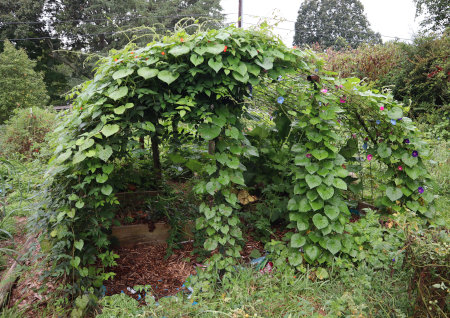
All I can say is, beauty is in the eye of the beholder. Everything is overgrown and runaway so that it looks a mess. But almost everything in it is useful!

Here we have cherry tomatoes, watermelon, mangels, horseradish,
celery, lambs quarter, sweet potatoes, raspberries, cowpeas, landrace 
brassicas, morning glory, a couple of carrots, and a potato plant or two.
Hoophouse: The living shade you see is hopniss, cherry tomatoes, and morning glories.

Also a volunteer winter squash, cultivated grape, and Chinese yams.

My largest sweet potato squash so far.

Inside the hoophouse are winter squash, Malabar spinach, violets,
strawberries (back right bed) and cultivated burdock (back left bed.)

Hugelkultur: winter squash, turtle beans, cherry tomatoes,
chicory, clover, morning glories, lambs quarter, & sunchokes.

Hugelkultur closeup featuring squash and chicory.

African keyhole garden: sweet potatoes and a survivor kale.
The porch trellis is growing green beans and cherry tomatoes.

I planted kale in the keyhole bed about a year ago. This is one of
two plants that survived both our cold winter and hot summer.

Picking and Preserving

Bucket full of cherry tomatoes, a few okra, and one lone pepper.

The cherry tomatoes are still going gangbusters. I got bored with making and canning pizza sauce, so I'm switching to tomato juice and ketchup.

The cucumbers are done, so our salads, now, are cherry tomatoes and kale.
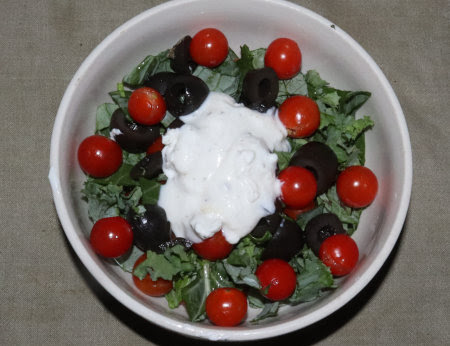
Tomato, kale, and black olive salad
with homemade ricotta ranch dressing.

The okra hasn't been very productive. 

Okra is a member of the hibiscus family.

I don't plant a lot, just enough to have oven-fried okra a couple times a week during growing season, with a little extra to freeze for a side dish during winter. It hasn't produced that much, although it's making a better effort now that our daily highs aren't so scorching and we're getting a little more rain.

August is fig month, and these are the largest figs we've ever seen on our trees.


They aren't all this size, but it's amazing to find them. Can't take any credit, though, because the fig trees are pretty much on their own! They are next to the goat barn, so perhaps they're getting some rich rain runoff.
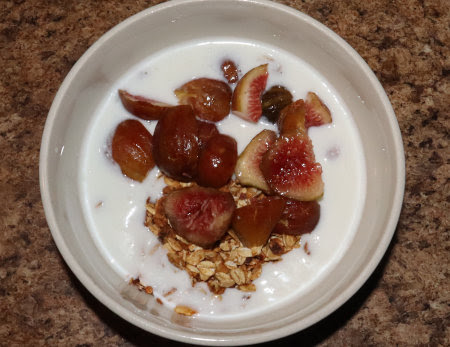
Breakfast: fresh figs on peanut butter granola with
kefir. Sometimes we swap the figs for diced pears.

There were lots to can.

And dessert!

Fresh fig cake with vanilla goat milk ice cream.

Pear harvest started in late July. The heaviest harvest was a couple weeks ago.

Bucket of pears.

One year, I spent days in the kitchen canning chunked pears, but Dan wasn't very enthusiastic about them. So now, I just make pear sauce. It's easier and faster to do, and we both like it.

Cinnamon pear sauce.

As pear picking slows and the pearsauce jars fill, I switch to drying them. Ditto for figs.
 
The cores and peels are being made into vinegar.

Elderberry harvest starts in late August.

First of the elderberries.

I used the first of them to flavor my canned figs and pearsauce. I also freeze them for jelly making this winter, and will make a couple batches of elderberry wine. This year I want to try an elderberry pear wine. I've experimented with adding other fruits for subtle flavor (of which some are more likable than others).

And a few parting shots.
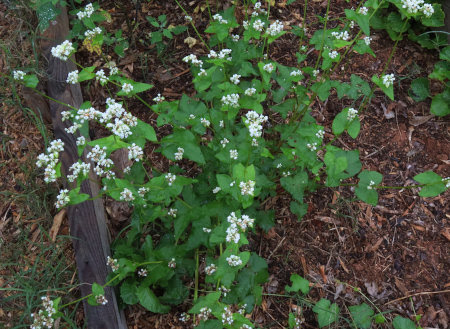
Buckwheat planted as a cover crop in my newest swale bed.
Only a few plants came up, so this will be my seed crop.

Marigolds and a winter squash blossom.

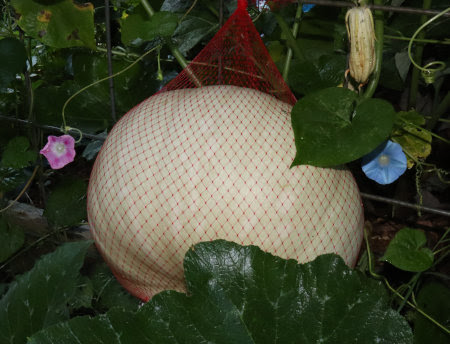
Our first Orange Glo watermelon of the summer.

I picked the watermelon just the other day. They were planted late, and only after my cantaloupe plants all died. I'm not sure what happened to them. They were doing well until our hot dry spell. I watered them faithfully, but they weren't happy and that was that. The watermelons have done much better and we're just starting to enjoy them.

So there are the pictures to go along with my Summer Mantra blog post. I liked hearing about what you all have been up to in your gardens, so keep the comments coming. 😀

July 13, 2022

A First Try With Hugelkultur

Last winter, when we were making our garden swale, we dug up a lot of dirt. Some of it became a berm on the downhill side of the swale, but with some of it, Dan decided to try hugelkultur. 

Hugelkultur is a permaculture term that I'm sure a lot of you are familiar with. It's German for "mound culture," which is actually a type of raised garden bed. It's built from dead logs, soil, branches, and sticks. According to richsoil.com, hugelkultur decreases the need for irrigating and fertilizing, plus it sequesters carbon. Since it's pretty much just buried wood, it's a productive way to use up rotting wood, twigs, branches, even whole logs, rather than dumping or burning them. Hugelkultur beds are primarily mounds, but can be made in trenches to be ground level (like my swale beds).

I confess I've been a skeptic because I've read reports from others in hot climates that say they don't work. I even mentioned this in 5 Acres & A Dream The Sequel. 

"Other gardeners were raving about hügelkultur beds, so I put some research time into the idea. While they seemed to work well in mild climates with fair rainfall, gardeners with hot summers and annual dry spells like mine were giving up on them. Hügelkultur beds appeared to work better in some climates than others. Mine was one of the others."
“Food Self-Sufficiency: Feeding Ourselves,”
5 Acres & A Dream The Sequel (p. 61)

I think what changed my mind was Permies.com, where hugelkultur is a basic tenant of permaculture gardening. The key seems to be the size of the mound. Many people seem to make small mounds, which will dry out quickly. The bigger the mound, the more moisture it can hold. Dan wanted to give it a try, so here we are. Now, I'm wondering if I'll have to eat my words. Well, I hope so! Since we have an abundance of dead wood (mostly pine), hugelkulture would be a great way to deal with it.

Here's our hugelkulture in pictures.

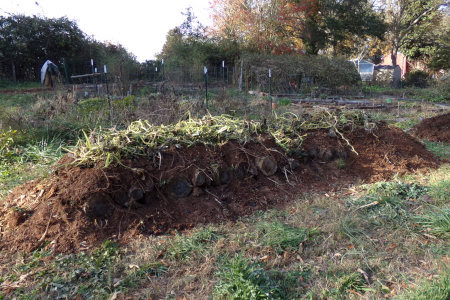
Some people dig them out first, but Dan started with a long pile on the ground.

On top of this, he added sections of old pine logs.

He covered each layer with some of the soil from the swale.

Close-up. Longer longs could have been used parallel to the build,
but these smaller sections were much easier to move and handle.

The whole thing was covered with dirt and then I tossed on a
 clover and pasture forage mix, and covered it with compost.

My concern was that the seed and compost would wash downhill when it rained, It did, though not as badly as I anticipated. In the bare spaces on top, I  poked winter squash seeds into the soil. On the sides, I planted black turtle beans.

May.

June.

Close-up of the forage mix: crimson clover and chicory.

Close-up of one of the squashes planted on top.

Here it is now.

July
Close-up of the squash and chicory flowers. The crimson
clover is done flowering, but red clover is starting to bloom.

I have to say that I'm quite pleased with how well our hugelkultur mound has grown. I know it will take some time before all those logs and sticks break down enough to be of best benefit, but it's a start. The only thing I've watered has been the squash seeds planted on top. The top is where it dries out most quickly, and I want the squash to survive.

Time will tell how successful it will be in the long-run, but so far, so good.

Has anyone else experimented with hugelkultur? What did you think?

May 11, 2020

African Keyhole Garden

While I took a week's break during the book giveaway, I worked on my own book and we finished our African keyhole garden. I told you about our plan in my Spring Clean-Up post, and Dan got right to work on.

What exactly is an African keyhole garden? It's a brilliant concept for raised bed gardening. It combines growing, composting, and watering into one manageable system. It's ideal for areas that have inadequate rainfall. The round bed is roughly 6-feet across with a compost container in the middle and a built-in path to easily add compostable materials and water. It can be any height one chooses.

Resembles a keyhole overhead, hence the name.

The keyhole wall can be constructed from anything: stone, logs, boards, sticks, wattle fencing, metal or fiberglass roofing panels, even sheets of plastic. Dan decided to use brick for ours because we still have a huge pile of bricks leftover from when we tore down the old fireplace and chimney ten years ago. Here's how he did it.

The first step was to level the ground and calculate how many
bricks would be needed for a 6-foot diameter keyhole garden.

He leveled a base for the footer with gravel and sand.

Brick footer filled in with clay subsoil.

The brick wall goes on top of that.


It took about three days to get to this point.

Compost bin made with ½-inch hardware cloth. It's about 20" across.

Keyhole gardens are typically filled lasagna garden style, but we
did ours more hugelkultur style with chunks of wood on the bottom.

Spaces between the wood chunks were filled with woodchips & topsoil. I
tossed in old corn cobs and husks, and bones leftover from making broth.
>
Almost done. Topsoil, compost, and fine woodchips continue
the fill. A cover could be added to the compost bin if desired.

The beauty of this system is that the compost bin is built in specifically for the keyhole bed. Contents of the compost are higher than the soil, which is sloped from the edge of the compost to the keyhole wall. Because the bin is made of hardware cloth, moisture, nutrients, humus, and organic matter automatically leach into the soil.

Planted with calendula, sweet basil, Jericho lettuce,
borage, and Five Color Silver Beet Swiss chard.

And there it is. Every day now, I'm out there inspecting for little seedlings! I'll keep you updated on how well it works.

Parting shot: Dan got his blueberry bushes transplanted too.


For more information, pictures, and ideas, check out this article, "Keyhole Garden" at insteading.com.

African Keyhole Garden © May 2020 by Leigh