Showing posts with label agrarianism. Show all posts

March 25, 2025

Agrarian New Year's Goals

According to the old agrarian ways, March 25 marks the beginning of the new year. You can read all about it in this post, so for now, I'll just say that this makes more sense to me than sticking the new year into the middle of winter.  

Spring is a great time to start working on new goals, and Dan and I spent the earlier part of the month making lists and discussing priorities. 2025 is going to be the year of maintenance and repair. We honestly don't have any major improvement or building projects. I guess finishing the last two rooms in the house would be about closest to that. 

Seasonal spring tasks focus on planting, so that's the upcoming priority as we approach last frost. Then summer will give way to harvest and preservation. Besides that, there are less pressing things like spring cleaning, annual fence maintenance, cleaning up areas that have become messy (like where our dead fig trees are), purging saved building supplies we'll likely never use (old storm windows and T&G from the front bedroom walls), repairing the foundation of our little garden shed, and repainting the outbuildings.

It's nice to have nothing pressing on the horizon. I know many people strive to avoid the mundane, but being able to take life day by day, to appreciate the little things, to maintain contentment, is so much less stressful than the habit of seeking excitement. It's one of the biggest reasons we chose this lifestyle.

How about you? Are you making plans or just winging it? Anything interesting coming up in your lives?

January 23, 2025

Winter Reading

Sam not reading.

Like much of North America, we are hunkered down to endure the frigid cold. We haven't broken any record temperatures, but this is the longest sustained stretch of cold that I recall in quite a few years. With critters, we still have outside chores and checks to do, but we have more indoor time, and for me, that means more time for weaving and reading. After keeping a book list last year, I'm inspired to do another one this year. Here are the first of my entries. 
 
Of physical book reading, I just finished Sharpe's Tiger by Bernard Cornwell. If you like historical fiction, you'll find Bernard Cornwell to be one of the best. His work is extremely well researched and the stories are captivating. The Sharpe's series was about the only thing of his I hadn't read, because our library doesn't have the entire series, including this one which is the first book. But Dan got it for me for Christmas, and I'm hooked. 

Historical fiction acts as a springboard for me, as I wonder what the historical facts actually are and what life was like in that time period and region (in this story it's India in 1799). The book I've just started on is nonfiction, focusing on a small "undeveloped"  region in northern India.

Ancient Futures: Learning From Ladakh by Helena Norberg-Hodge is an extremely interesting book in two more categories I like: culture studies and agrarianism. The author spent a number of years in rural northern India as a linguist, experiencing their culture and witnessing the influence of encroaching global industrialism. While most of the world sees this influence as necessary and positive, the author saw the gradual destruction of a healthy, self-sustaining eco-community being pushed into dependency on modern consumerism. It impacts not only their so-called "standard of living" but also their mental, physical health, and cultural health, and not for the better. Her message is that we need to heed and preserve the benefits of such ancient socioeconomic systems. 

When I'm weaving or doing other handwork, I listen to audiobooks. 

While I was reading Sharpe's Tiger, I listened to G. A. Henty's The Tiger of Mysore, also fiction, also set in the same place and time period. It gave me a slightly different perspective and different details, which is another reason I like historical fiction. (The link is to Librevox, where you can listen to it for free, the physical book is available here.)

I thought Henty told a good story with interesting facts, so I chose another of his works to listen to next. This one related to my interest in genealogy, Wulf the Saxon: A Story of the Norman Conquest. (That link is to Librevox. Physical copy can be purchased here.)  It's interesting to hear how one branch of my family tree fought and conquered another branch. That became a springboard for what I'm listening to now, William the Conqueror by Edward Freeman (title links to Librevox, physical copy here).

While I don't usually plan my reading too far ahead, I do have the next paper book and audiobook lined up: Sharpe's Triumph, the next in the Cornwell series, and The World Until Yesterday: What Can We Learn from Traditional Societies? by Jared Diamond on CD.

How is everyone else faring the cold? Are you reading? What are you reading? Any good recommendations to share?

March 16, 2022

Our Agrarian Year: Spring Project List

March (the old agrarian new year) marks the beginning of spring, which is planting season! Our project prioritizing motto is "food first." So, hopefully, we've gotten the maintenance and winter projects to a good stopping point, so we can set everything else aside to focus on planting. Even if we haven't, this seasonal project takes priority over everything else, save emergencies.

Seasonal

  • Planting
    • Annual food crops
    • Pasture forage
  • Cleaning out the barn (of which the winter's accumulation of deep litter is spread across newly planted areas in the pasture)
  • Prepare for April kidding
Infrastructure
  • Continue working on swales

We hoped to get further on the swale project during winter, but we have a couple of obstacles to deal with for which there are no easy solutions. 

Obstacle 1:

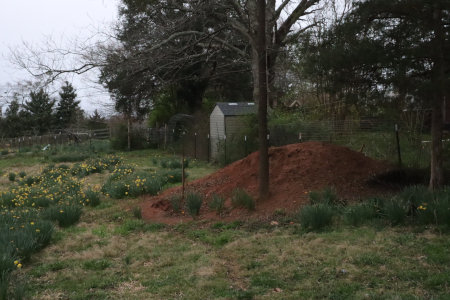
Big pile of dirt where the swale needs to go.

That pile came from the old swimming pool, which Dan dug out to see if we could do anything useful with it. That's where he put the dirt, and that's where it's stayed for over two years now. Our tractor doesn't have a front end loader, and trying to move it all by hand is a discouraging idea, so there it's sat. 

Obstacle 2 is related, i.e., lack of equipment to move the dirt and dig the swales. We dug the garden swale by hand, which was fine, but pasture swales will be much larger undertakings. We'll probably end up renting something; not a cheap option, but certainly cheaper than buying equipment.

Miscellaneous

These are things we need/want to do but which haven't made it to the top of the list yet. It's an ongoing list that is good to keep at hand, in case weather, time, necessity, or change of plans allows us to tackle them. This list never goes away, because as we cross things off, we add things too.
  • Finalize design and materials list for masonry heater (construction will be a summer project)
  • Do something useful with our remaining two solar panels
  • Finish the exterior of the house
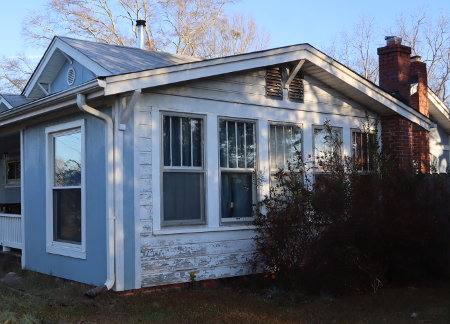
Of the house exterior, this is all that's left . . .

Last exterior wall in need of new siding and paint.

Not much, is it? So you'd think it would be done by now! The holdup here is that we've discussed adding on a small greenhouse here, but so far haven't been able to decide/design what we want to do. And that's why it's been on the project list for so many years! Maybe 2022 will be our year of success (???)

So, there it is. A very short list of the projects that will occupy most of our outdoor time this spring.

How about you? What are your plans for spring?

January 1, 2022

Our Agrarian Year: Winter Project List

By the beginning of December, the trees have shed their leaves, and shorter days and frost have ushered in the dormant season. The days start later, the pace is slower, and the chores are less pressing. Of the winter season, December is our mildest month, so we get more done outside. January and February are our coldest months, so outdoor work is more iffy. When the weather's bad we work indoors, plan, and enjoy some leisure time. 

Our current winter project list is divided into several sections: seasonal activities, one-time infrastructure projects, and research for future projects. 

Seasonal

  • log milling
  • wood chipping
  • garden maintenance: beds, aisles, mulch, etc.
  • fence maintenance and repair
  • freezer canning
    • frozen tomatoes ➞ tomato sauce
    • frozen figs and berries ➞ jams and jellies
    • frozen goat cream ➞ ghee
Infrastructure

  • swales - planning and digging (getting a start, anyway)
  • forest garden - planting

Research and planning 

We have two large projects that we'd like to work on this summer. Winter is a good time to explore options, formulate specific plans, and calculate costs.
  • Finish the exterior of the house, of which only the sun room is left. We've batted around the idea of attaching a greenhouse there, but have always gotten bogged down by how far we want to go with preliminary steps. When it seems to get too complicated, we set the idea aside and move on to something else. Eventually, though, we need to finish the house! My permaculture design course with Bill Mollison and Geoff Lawton discussed greenhouses (glasshouses) extensively from a permaculture perspective, i.e., not only for growing food, but also as a way to passively heat a house in a temperate climate. So, we're going to take a closer look at doing this the permaculture way and hopefully make a plan.
  • Masonry heater: to replace the wood heater in the living room.  

Leisure

Since the winter season has the fewest chores and the worst weather for outdoor projects, it's a good time for hobbies and self-improvement. For me, that means learning how to use my new camera with an online camera course. I'm just a couple of lessons into it and learning a lot! Lesson notes and homework are posted on my photography blog.

So, what is everyone else doing this winter season? Projects? Planning? Taking it easy? Please share!

Winter Project List © January 2022 

September 12, 2021

Fall Garden: Planting By Length of Daylight

Several years ago, I blogged about what I had learned about soil temperature and plant growth ("What I'm Learning About Fall Gardening.") For awhile, I tried to plant my fall garden after the soil temperature dropped below 80°F (26.6°C). But for some reason, taking the soil's temperature everyday became extra chore that got lost in the huge pile of other things to do. The other day, I was reading Debby Riddle's blog Riddle Family Farm, and she mentioned the Persephone season. I had completely forgotten about that. I shouldn't have, because the concept is extremely useful for fall and winter gardeners.

The Persephone season is a concept that Eliot Coleman mentions in his books, The Winter Harvest Handbook and Four Season Harvest. The story of Persephone is a mythological explanation of why most plant life becomes dormant in winter. Technically known as solar winter, Eliot's observation is that plant growth pretty much ceases when daylight is less than ten hours in length. For fall planting, the recommendation is to get cold tolerant crops planted so that they are fairly well established by the time solar winter begins. A good estimate of that is approximately 75% of their days to maturity.

According to TimeAndDate.com's sunrise and sunset calculator for my location, 10-hour days begin November 30 for me. So, for example, if a seed packet lists 60 days to maturity, I'll calculate 75% of 60.

60 x 0.75 = 45

So I count back 45 days from Nov. 30 and plant my seed before that date. In this case, before October 16th.

I'm not discounting soil temperature, but have to say that for me and my lifestyle, having a set date really helps. My cooperative extension says to plant fall crops in August, but it's often so hot and dry in August, that planting just doesn't feel right. And I know from experience that if I wait until late October, I'm not planting a fall garden, I'm getting an early start on the following year's spring garden. Intuitively, September has always felt right, so working this out systematically has been very affirming.

This dovetails beautifully with my agrarian year. My winter months are December, January, and February, and I find it fascinating that solar winter for my location begins the last day of November. I love it when all the pieces fit so neatly together.

March 1, 2021

Happy Agrarian New Year!

 A couple of years ago, I wrote a blog post about why the old agrarian calendar makes more sense to me than our modern commercial calendar. The roots of that old calendar go back to the ancient Hebrews and Babylonians, and trace their way up until the mid-1700s, when the new calendar was finally adopted by the last of the hold-outs—farmers. Follow the link above for details. Because most of what Dan and I do is so seasonal, this old calendar makes sense. Plus, I confess that the commercial new year in January holds no emotional significance for me. So, the agrarian calendar just feels right.

In my part of the country, March 1st makes a good beginning of the food growing year. We're roughly six weeks out from last frost, so it's time to get in gear. We're just coming out of winter—the season of rest (Ha!)—which is a good time to reflect and evaluate. It's also a good time to plan. When March dawns, spring is in the air and it's time to get busy!

Everything revolves around seasonal chores, of course. In spring, it's soil preparation and planting, which includes both garden and pasture. Summer is busy with harvest and preservation, and is also when Dan works on wood for the following winter. Toward the end of summer, there's a fall garden and winter pasture to plant. Harvest and preservation finally taper off in autumn, which is the season to prepare for winter.

After the week's seasonal chores have been tended to, it's project time! Here's what we hope to accomplish this year:

  • Fencing. This includes maintenance, repair, and new. The new is around the buck barn and chicken yard. Maintenance and repair are everywhere else.
  • Outdoor Kitchen. We've talked about this for years, and the ideas and plans are finally coming together. Details soon.
  • Heat stove. We're looking at replacing our soapstone stove with a masonry stove. More on this one of these days.

Of course, everything is weather permitting. However, we have a nice mix of both outdoor and undercover projects to always be working on something. That's a good feeling. :)

July 4, 2019

A Birthday Lament for America

On this 243rd anniversary of the birth of the United States of America, I cannot help but reflect on the ideological divide that currently has this country in its death grip. While some would consider this progress and reason to celebrate, others lament this as a sad state of affairs. But like the frog who will instinctively jump out when thrown live into a pot of boiling water, we have been willing to sit in the cold frying pan while the heat is turned up so slowly that we've barely noticed what's happening.

In 1973, Eric Sloane published a book entitled The Spirits of '76. It was written in anticipation of then upcoming bicentennial of the United States. In this book he identifies and laments the loss of ten qualities that could be considered the foundational American mindset at the time of this nation's birth. Following are a series of quotes from The Spirits of '76. They seem appropriate to reflect on today.

The Spirit of Respect

"Respect for family, respect for the nation and the land, respect for the flag and the law, respect for mankind and respect for oneself ---these have been outstandingly wanting during the last few years. Within the family, within the nation, and to all other nations, the only hope for the survival of civilization is respect or love for one another. In the end, this is all that matters."

The Spirit of Hard Work

"Once upon a time in America, hard work was a part of life; it was one of the pleasures and satisfactions of living. Even as I write these words they have a ridiculous ring to my ear, so conditioned am I to the popular American creed of seeking the most pay for the least amount of work. Hard labor is considered either drudgery or punishment, or, at best, a necessary evil. . . Retirement from labor has become a national aim, and the physical and mental pleasure from hard work has become a vanished American spirit."

The Spirit of Frugality

"Throwing things away has become an American habit. It has been estimated that we waste more in one second than our gross national economy earning of two hundred years ago. There were no garbage dumps in those days because all leftovers were reused. . . The spirit of frugality began its decline slowly until the last few decades of acceleration, when we have overcome the fine art of saving and finally established a unique economy of waste."

The Spirit of Thankfulness

"Pioneer Americans were rich in the spirit of thankfulness. . . It was the proper way of life in those days to be grateful often and express it openly. . . The art of being thankful in America has not progressed in spite of two hundred years of all sorts of amazing things to be thankful for. The gifts of life are more and more taken for granted and the general belief is that we constantly deserve more than whatever we already have."

The Spirit of Pioneering

"Without adventure, civilization is automatically in the process of decay. . .It has always given me wonder why ninety percent of the people choose to live in ten percent of America's landscape, subjecting themselves to the insidious debasement of overcrowding. Out there between cities, in mountains and prairies, are still hundreds of thousands of empty acres of adventure and health and meaningful living, being ignored by both people and government."

The Spirit of Godliness

"A religious regard for nature and the spiritual is an indispensable element of greatness. As man develops and disturbs nature's relationship with the Creator, not only does the quality of the landscape become mediocre but the same loss of character seems to occur to the disturber himself. . . It is strange that in an age of scientific greatness, there should be an increasing mediocrity in mankind."

The Spirit of Agronomy

"Farming was the classical way of American life. . . Push-button machinery and synthetic manures have pushed agronomy so far from nature that the modern farmer is seldom more than a businessman in overalls or a rural manufacturer. . . Farming is geared only to big business and the spirit of agronomy is a vanished American trait."

The Spirit of Time

"We have become artists at the business of going fast. . . Although people used to have a righteous contempt for anything done in a rush, speed has become today's fullest measure of efficiency. Time-savers are an obsession, but the time saved is only squandered; it is like hoarding money in order to be extravagant."

The Spirit of Independence

"Everyone knows about 'the American Heritage' but, when asked, few can say what that heritage is. Boiled down to a sentence, what made us different. . . was independence and total respect for the individual. . .  Already mass produced machinery has created a mass-produced civilization in which the individual often has less importance than the machine. Individualism is in the twilight of its favor: mediocrity finds both safety and acceptance in standardization."

The Spirit of Awareness

"The most important difference between the early American and his modern counterpart, if boiled down to one word, was awareness. The early life was saturated with the essence of awareness that made living a vital experience. . . The extent of unawareness today would be unbelievable to the early American. All the necessities of life being made for you or done for you by someone unknown from somewhere unknown, produces a dehumanized existence in which the only part left for us to play is to pay out money in exchange."

These are the values I learned from my grandparents and read about in books by authors like Eric Sloane, Laura Ingalls Wilder, and Ralph Moody. Yet, I'd say most people today would view these ideals as antiquated or naive. Because they have all but vanished from modern thinking, I suspect that to many they make no sense, especially those who only know the rewritten version of American history.

But can you not imagine a nation (any nation) in which the individuals who lived there respected themselves and the rights, opinions, and property of others? Who respected the earth and the environment. Whose lifestyles created no waste. Who were willing to see hard work as creative and giving purpose. Who were grateful for what they had. This is the mindset we consider nostalgic and the lifestyle we consider backward. This is the spirit of America we have walked away from.

Most people would say we can't go back, and sadly, I have to agree with them. But if that's the case, exactly what are we heading toward? We are now a nation that makes demands with disrespect, tries to manipulate public opinion with political hysteria, and thinks it can force changes in behavior through restrictive laws. The problem is that these tactics do nothing to unite people in a common confidence of the proposed solution. They only deepen the divide. Is this really what we want?

What do you think?

March 25, 2019

Happy Agrarian New Year!

Something that has always seemed odd to me is that the beginning of a new year is in the middle of winter. That isn't strictly true of all cultures in all time periods, but it's been standard enough for long enough that I doubt few folks give it a second thought. When I read Eric Sloane's The Seasons of America Past I learned that the old agrarian calendar began the year on March 25. This makes sense to me! So here I am, wishing you a Happy Agrarian New Year.

The roots of this go back to the ancient Hebrew, Canaanite, and Babylonian calendars, where the first month started in the modern late March. The early Romans celebrated the new year on March 1st, but this was changed in 45 BC with the Julian calendar. It made January 1st the beginning of the new year. The best I can figure out is that this was done because the month's namesake, Janus, was the god of new beginnings. When Pope Gregory XIII had the calendar revised in the mid-1500s January remained the first month. 

The Gregorian calendar is the one we still use today, but March 25 remained the start of the new year in parts of Europe for a long time. England was the last holdout until 1752. According to Eric Sloane, early European American farmers continued to use March 25 as the first of their year, as documented by old farm calendars, almanacs, agricultural manuals, and personal diaries. 

With March as the first month, the quarters of the year make sense because the seasons correspond with the work for that time of year.
  • March, April, May - planting
  • June, July, August - growing
  • September, October, November - harvest
  • December, January, February - hearth
As you can see, the rhythm of the agrarian year is set by a relationship with the seasons and with the land. 

Last November I asked my readers to define agrarianism off the top of their heads (that post here). I promised to get back with you on what I thought, so this is the first of a series of posts exploring that. My understanding of agrarianism is that it isn't simply agriculture, it's a worldview.

What is a worldview? It's how an individual perceives the world and the way it works. It answers life's fundamental questions about the existence and nature of God, the origins of the universe, the place and purpose of humans, what happens after death, and how we determine right and wrong. Obviously there are many worldviews. Agrarianism is the one that makes the most sense to me.

The agrarian new year had it's own traditions in the rural US. It was celebrated with mead, and cider and doughnuts. It was the time to begin looking ahead to planting, with one of the first chores of the year being fence mending. It was also time to begin the laying up of the next year's firewood and splitting logs for fence rails. In the north it was (and still is) maple sugaring time.

Dan and I didn't have any mead, cider, or doughnuts, but we have been looking ahead to planning the planting season. Of course that includes the garden, but also we're been planning to expand our hay growing. We're going to work on our hedgerows and continue pasture improvement. Last week he cut the first tree to start curing for next winter's firewood and we have indeed started working on our fences. Some of them are in bad need of repair!

Of course, our spring begins earlier than others. And those who live south of the equator will be in the opposite season! But we all adapt, don't we?

How about you? Do you have seasonal traditions or tasks for March?

Happy Agrarian New Year! © March 2019

November 1, 2018

Research Question For My Readers

For chapter two. I would like to know how you would define a particular word. There are no right or wrong answers, and your answer doesn't have to be lengthy or profound. Just off the top of your head, tell me what you think of when you hear or read this word.

How would you define?
agrarianism

Thank you for taking time to help!

April 22, 2016

Time Versus Money

Now this is a topic that everyone can relate to. Who doesn't struggle with the dilemma of time versus money? Do I save money and do it myself, or do I save time and buy it? That can mean buying the item outright, or hiring someone to do some work. Sometimes doing it myself means having to buy the tools and supplies necessary to get the job done. Which is the better choice? I don't know about you, but sometimes one wins out, sometimes the other.

Modern thinking tends to assume money represents leisure and freedom from work, i.e. the more money I have the more toys, entertainments, and free time I can have. Here's a real life example: When the kids were growing up, Dan and I believed they needed a full time mother. Also we believed in homeschooling. Every single person we encountered (except for other homeschoolers) assumed that I stayed home because we could "afford" it. That Dan made a big enough salary so that I didn't have to work. No one seemed to guess that we did what we did out of a spiritual conviction, and that some things are more important than money. The reality of our situation was that we really tightened our belts and lived what others would consider a denialist lifestyle.

I don't think it was always that way. Do you remember in Farmer Boy about Almanzo, his father, and the pumpkins?

     Father asked: "Almanzo, do you know what this is?"
     "Half a dollar," Almanzo answered.
     "Yes, but do you know what half a dollar is?... It's work, son. That's what money is; it's hard work... Say you have a seed potato in the spring, what do you do with it?" ...
     "First you manure the field, and plow it. Then you harrow, and mark the ground. And plant the potatoes, and plow them, and hoe them. You plow and hoe them twice... Then you dig them and put them down cellar."
     "And if you get a good price son, how much do you get to show for all that work? How much do you get for half a bushel of potatoes?"
    "Half a dollar," Almanzo said.
     "Yes," said Father. "That's what's in this half-dollar. The work that raised half a bushel of potatoes is in it."

When my kids were little there was a lot of social discussion about mothers and going to work. That was before the supermom myth had been busted and women were looking to have it all. I think it was Dr. James Dobson (or was it Larry Burkett?) who recommended that mothers count the cost of a job before assuming that having a paycheck would mean they had more money: childcare, transportation, wardrobe, meals, vehicle maintenance, and conveniences to make up for one's lack of time all add up. I've had friends who told me that their job was actually costing money rather than making money.

I mention that because the principle also applies to some aspects of homesteading. A couple of years ago I wrote a blog post about growing our own goat feed, and I received a comment that said it sounded like too much work. The point is, it's work either way, whether I grow it myself or buy it. If a bag of feed is $15 and I make $10 an hour, then it "costs" me an hour and a half of my time to purchase the feed (plus the fuel and time to go buy it). If I make $30 an hour, then it's only a half hour of my labor. The question then becomes, would I rather go work for someone else to pay for my feed, or work for myself (and my goats)?

Sometimes we have more time than money, sometimes we have more money than time. Sometimes it's the little things which are personally important that tip the balance. There is no way to say one choice is better than the other, but I would say it is wise to count the true cost and then make choices based on our goals, priorities, and what we believe will achieve the most beneficial outcome.

November 20, 2015

Parade of Junk

I'm grumpy. That means that this post will come off as something of a rant, but don't say you weren't forewarned!

Why am I grumpy? Because I've taken a liking to peanut butter and jelly on toast for breakfast, and my toaster oven died. The problem isn't so much having to change my favorite breakfast, as it is our continual parade of junk consisting of things we've purchased, such as drip pot coffee makers and laundry baskets, that are kaput after about six months or a year. Many readers will likely nod their heads in sympathy over this problem.

The modern world has a disposable mindset. The irony is that it rallies behind "green" products and recycling, but for all the talk and hoopla about these things, nothing really changes except that prices go up and quality goes down. It seems to me that we have something of a 3-ring circus going on, with everyone pointing the finger at someone else. We have industrial manufacturing and agriculture in one ring, the economy in another, and the environmentalists in the third.

Let's start with the third ring, since global warming, climate change, carbon emissions, and petroleum dependence are so much in the news these days. It's interesting that the target object for all of this is usually emissions, mostly automobiles. Rarely is it pointed out that the majority of plastics and all their cousins are petroleum products. And what, in the parade of junk, isn't made with at least some plastic (or all) these days? Then there's the energy cost to manufacture and transport those goods, plus all that packaging which must be dealt with. But don't get me started on that.

In the second ring, business people tell us they only sell what the public wants. Baloney! I mean, who really wants to keep buying a new coffee pot or laundry basket every six months? Or a new toaster oven every couple of years? The truth is that we can only buy what they offer to us. Don't show it to us and we won't even know to want it. So called "better quality" costs more, but is it really? Somehow I doubt it.

Then there's the economy, which is based on the industrial model. It's so called "health" revolves around "growth." In other words, they have to keep making more and more money to keep their investors in dividends and their CEOs in bazillion dollar bonuses. There's the real culprit! Let's just all grow a little garden and be satisfied and content with living simply and modestly - problem solved!

Don't even bother with the government. Every time they pass laws to make things "better," it only means things get more expensive, with all that expense passed on to the consumer.

This is madness. How long can it go on?

< /rant>
Parade of Junk © November 2015 by

April 12, 2014

Stewardship, Balance, and Market Mindset

"What are you going to do with all of them?" Dan asked when I called him with the good news about Lily's triplets.

"Well, I don't have to think about that yet," I replied. "They need to grow up a bit so we can evaluate which ones to keep."

Kid races. This is one of the few photos I've managed with all 8 in it!

Actually, we'd love to keep all of them, but that isn't possible. As Dan and I talked, I commented how in biblical times one's flocks were a sign of one's wealth. Not so today. To the modern mindset such a notion is primitive and ignorant. After all, wealth is all about money, isn't it? Accumulating wealth is about investments and 401Ks, right? Not about having more goats. Goats Animals are an expense.

Ziggy's 3 on left, Surprise and her twins on right. Introductions are always
supervised. I especially don't trust Surprise. I saw her grab one of Lily's girls
by the head and give her a toss. Eventually everyone gets used to one another.

In fact, too many animals can seem a liability when one considers how expensive it is to keep them: feed, hay, minerals, fencing, housing, equipment, vet bills. It all adds up so that goats, indeed, most livestock, are more in the hobby category. In other words, keepers of goats have become another marketing demographic. In fact, in a cash economy it is not desirable that we should provide for them ourselves.

Miracle meets Ziggy.

One of our goals from the very beginning was that we would keep no more animals than our land can support. This is because we have a very strong sense of stewardship regarding both. We want both our land and our animals to flourish. We do not want to sacrifice the land for livestock. We do not want to run it down and wear it out.

After introductory sniffs, Ziggy wasted no time in teaching Miracle a lesson
about respecting her elders with  a good swift butt, sending her off crying.

This implies balance. I admit we are still working this out and are constantly wondering how many animals we can keep. I'm not just referring to grazing, but to being able to grow everything our goats need to be healthy. This is why we invested in our soil by remineralizing. If we feed the soil we'll feed the plants. The plants will feed our animals and us. It makes so much more sense than trying to meet nutritional needs with purchased feed formulations and vitamin and mineral supplements.

These two of Ziggy's triplets definitely show their Nigerian Dwarf genetics,
being smaller than their sibling. I've taken to calling them Jack Rabbit (left),
for his ears and darting about, and Teddi Bear, because she has a fuzzy face.

Maintaining a balance means determining which goats to keep and which ones to cull. By cull, I don't automatically mean kill. Although we do eat homegrown goat meat, culling simply means selecting which ones to cut from the herd. Mostly I do this through sales and trades.

Ziggy's first born. I call him Jump. Not because he
jumps over, but because he jumps up to be petted.

Last winter was an important lesson because it was so cold. Our winter pasture and cold weather vegetables went dormant, leaving us to rely more on hay and purchased feed. I realized that I need to get down to a smaller winter herd every year. Sales and trades, however, require an interested party with whom to transact. When I tried to sell Hooper and Rosie I had only a few nibbles of interest.

Lily and son, the middle born of her triplets.

This was an important lesson too. If I don't want to keep too many goats over winter, I need to price them to sell quickly. The expense of feeding them all winter could obviously offset the few extra dollars I might get if I waited to sell them according to the prices set by our local market mindset.

Lily's buckling. Still nameless, although I'm tempted to call him "Spot."
The only thing that stops me is that it doesn't seem very imaginative, lol

That market mindset is a curious thing. It appears to be based on retail prices whether they are relevant or not. For example, have you ever noticed how thrift store prices go up whenever retail prices go up? That never made sense to me because everything thrift stores sell, they receive free, as donations. We could assume it has to do with their overhead is going up, but changes in utilities and rents take months or years to catch up with the rising cost of goods.

Miracle, Surprise, Grace, and Ziggy.

I've first noticed this with used looms. If I bought a new loom for $1000 and got 10 to 20 years of good use out if it, why is $2000 a good selling price? Yet this is common thinking amongst weavers. Or farm tractors. Why is a tractor which cost $1500 brand new 50 years ago, now worth $4000 when it isn't even running? And why does tacking "antique" or "vintage" onto it make it worth more? I know all this makes sense to some folks, but it doesn't to me. To me, the correlation between inflation and used goods is based on an artificial sense of value.

Surprise, Grace, Ziggy, & Ziggy's triplets. The kids all sleep in sibling groups

I finally realized that if I want to support my goats from my land, then it would be better to give them away before winter sets in, than feed them all winter because of some ethereal notion of what they're "worth." The bottom line is the health of my land, not making money from selling an occasional goat. In fact, I could easily overuse my land by waiting to make those few extra dollars from that goat. It could easily cost me more to rebuild my soil than what I thought that goat was "worth." On top of that, I can have the satisfaction of helping someone else. The tendency to price everything for "top dollar" leaves many of us making do without.

Lily's first doeling. Maybe Dottie? Another unimaginative name!

Back to goats. I initially followed that market mindset in setting prices for Hooper and Rosie. I priced them mid to low range based on what others were asking for their goats. Except no one was interested. All this goes back to a question I've written about before (see links below), how do we set value? By what the goat "ought" to be worth? By how much I've put into her?

Lily's girls in front, Surprise's Miracle behind. 

I realize I'm probably not making sense to very many folks, but this is something that is often on my mind. The modern world says everything is about money. But it didn't used to be that way. There was a time when economics were seen in a different light, one based on land and and a sense of community.

Meeting the older sisters, Zoey and Daisy. Zoey is one
of Ziggy's triplets last year, Daisy is one of Lily's twins.

Okay, I'm almost out of kid pictures, so I guess I can quit talking. :)

Lily's girls

Related posts and writings:
Ziggy, Lily, and their two sets of triplets


March 6, 2014

Agrarianism and Permaculture? My Answer

Many thanks to everyone who took the time to answer my question,


I asked the question because these things have been on my mind a lot lately. It's been something I've been mulling over quite a bit. When Dan and I bought our homestead almost five years ago, we had a strong conviction that this was something we must do. We had some skills and some experience, but it's been a journey nonetheless.

Our first five years were spent observing, planning, prioritizing, researching, building, fixing, experimenting, and learning. These years were the basis for my book, 5 Acres & A Dream The Book: The Challenges of Establishing a Self-Sufficient Homestead. In the book I referred to these first years as our "establishment phase." Each chapter addresses a different aspect of self-sufficiency and the learning curves we've faced for each one. Our biggest challenge, however, has not been something tangible such as learning how to grow and preserve a year's worth of food, or how to get off-grid. Our biggest challenge has been our own mindset, or world view.
"By this I mean one's expectations about how things ought to be, about life and society as we are used to them. It's our attitude, particularly about what we have, what we need, and how we get it. It's our mental image about cultural and lifestyle standards, of how life ought to be lived, how things ought to work"           Chapter 10, "Obstacles"

This was the focus of Chapter 10, "Obstacles," and is the topic of a number of my blog posts (see list of related posts at the end). This is the topic that is foremost in my mind now.

Why? Because now that the master plan is fairly set, the house has received many repairs and lifestyle improvements, and proper outbuildings are in progress, it's time to think beyond getting established. It's time to draw on what we've learned and put it all together. Hence this research question, for which I turned to you. As my homesteading cyber-community, your feedback not only helps me clarify my own thoughts, but as a writer, I need to know what you think if I'm going to engage you on an intelligent level in my writing. I will blog about it every step of the way and, perhaps, this may become the basis for a sequel to 5 Acres & A Dream The Book.

It does seem true that there is more written about permaculture than agrarianism. I'm sure many know that the term permaculture first came in to use in 1978 from, "permanent agriculture". Most simply defined, it is a design system for sustainable agriculture based on natural cycles and ecosystems. Popularly, it is used as a landscaping system in both rural and urban areas. Over the years the meaning has expanded to "permanent culture", with the hopes that it can solve many of the world's social problems.

Agrarianism is a rather ancient concept, and hence possibly more obscured in meaning over time. Because of that it is difficult to find a definition which describes it as modern day agrarians think of it. It is often thought of as agricultural, but agriculture can take many forms, from the single family subsistence farm to the multi-billion dollar industrial farm.

Personally, I would define agrarianism as a cultural, economic, and social system based on the land, on agriculture. To further clarify, the opposite of agrarianism is not urbanism, but rather industrialism, which is based solely on money and its byproducts - consumerism and commercialism. Historically agrarianism was community based and encompassed all manner of trades and occupations. The difference was that these communities were based on a dependence on the land, rather than a dependence on money (either "real" or otherwise).

So I agree with you all that permaculture and agrarianism are not the same thing: one is a design system, the other is a cultural, economic, and social model. That does not imply incompatibility, and many agrarians do indeed practice permaculture. A permaculturist, on the other hand, may or may not be an agrarian. The CEO of a large investment firm, for example, can have an extensive permaculture landscape, but could not, as such, be an agrarian.

Is agrarianism really so arrogant as to assume superiority over any other model? How one answers that is going to depend on where one's sense of security lies. The heart of the modern agrarian movement does not see the industrial economic and social model as sustainable. It is seen as self-consuming and doomed to fail. The call for change is an attempt to extend a lifeline to anyone who wishes to grab on, before it's too late.

Those are my beginning thoughts on it, as we work toward creating a sustainable homestead.  I do have more to ponder out loud and will blog about it from time to time. Please do continue the conversation with your comments. And below are a few related posts if you are interested.

Mindset: Key to Successful Homesteading?
Contemplations of Value & Money
The Lost Art of Bartering, Part 1
The Lost Art of Bartering, Part 2
Cultural Disengagement
"Good and Bad Investments For Farmers"
Agrarianism: Forward or Backward Thinking"

March 4, 2014

Research Question, Need Opinions!

Permaculture and Agrarianism. The same? Similar? Different? Why or why not? Let's discuss!

February 12, 2014

Agrarianism: Forward or Backward Thinking?

There was a comment made during my radio interview with Scott Terry which struck a chord with a lot of listeners. In fact I'm guessing quite a few homesteaders have heard it in one form or another too. It is the idea that agrarianism necessitates the abandonment of all technology, of all things modern. Many a homesteader has been accused of being a hypocrite for using cell phones, power tools, and the internet.

I think part of the reason for this is because agrarianism is thought of as an historical event, a way of life associated with pioneers and Little House on the Prairie. What is true, is that agrarianism is a cultural, economic, and social structure based on agriculture. It's not specifically rural because even merchants and tradesmen can be dependent on the land albeit in an indirect way, such as bartering. Today when we think of agriculture, the technology minded think of industrialized, centralized agriculture run by corporations. This is agriculture as a business endeavor rather than a way of life. Today, technology is the modern way of life.

Seeing technology as a standard by which to live reflects a dependence on technology without which life as we know it would cease to exist. This is true, of course, for most of the modern world. However, real life options are not technology versus no technology, but rather technology as a lifestyle versus technology as a tool. The difference is in either being totally dependent upon technology to function in the world, or in being free to use as many or as few technological innovations as one desires; even to live without.

Unfortunately, the technology-as-a-lifestyle mindset assumes that only technology brings progress. That any other way of thinking is anti-progressive. Progress as the ultimate good ignores potentially devastating consequences and never stops to evaluate the results.

The heart of the modern agrarian movement is not saying technology is evil, but rather dependence on it and the consumer system it fosters is unwise. Most of what it has produced is not sustainable: chemical agriculture depletes and poisons the land, dependency on consumerism produces mountains of trash in overflowing landfills, globalized food production gobbles up precious petroleum reserves for transportation, monoculture crop failures are catastrophic to the world food supply, genetically modified seeds are patented and illegal to save and plant, yet they are pushed on all of us including third world countries who really can't afford them. Science hasn't fixed any of these problems yet; what makes us think it ever will?

All of this is key to the simpler life many people long for. The very technology that is touted as being able to save the world is actually destroying it. But in the end, it boils down to individual choices; choices about how we choose to live and what we choose to buy. The homesteading movement and return to agrarian values is a reflection that people are beginning to understand there is a better way to live. It's not going backwards, it's a course correction. It's moving forward in the right direction.

January 23, 2014

Seasonal Living

There is a rhythm to the seasons that I've long thought we humans should be a part of. I'm not speaking of sports seasons: football, basketball, hockey, and baseball seasons; nor the consumer seasons where we buy Christmas items in September or swim suits in February; nor revolving the year around school with first day, graduation, and summer, winter, and spring breaks. I'm not even referring to what the calendar says when it declares a particular date "the first day of .....".

I'm speaking of the seasonal changes in weather and how they shape our way of life. Gardeners will understand this quite well, and farmers. The rest of modern society pretty much considers weather either "good" or "bad" depending on one's personal preferences and how convenient or inconvenient the weather is at the moment.

For the agrarian, the seasons not only influence the whens and whys things are done, they also give a comfortable rhythm to life. I've mentioned longing for this in a number of my homesteading posts, and I'll refer you to a really interesting read on the subject, The Seasons of America Past by Eric Sloane. It contains many things we probably wouldn't have thought of such as fence mending, well digging, and soap making; all had their seasons.

Odd as it may seem, we're just now getting to this, as in, this is the first year Dan and I have looked at the upcoming year in terms of seasonal chores. Until now we've been in what I call the establishment phase of homesteading. Planting, harvesting, breeding, and kidding have been part of this, but we've had to focus on things like repairs to the house, fencing, and outbuildings, all of which need to be done ASAP.

Earlier this month we started a seasonal chore list. It goes month by month and is of things we routinely do (or should do) during that month. Our coldest months are January and February, while our hottest are July and August. Of course weather and Dan's work schedule are factors, but even so, we wanted to develop a seasonal guideline for what needs to be done. This is just the beginning, but here's what we've got so far:

January
  • rake leaves & mulch garden
  • spray fruit trees
  • transplanting
  • garden planning & seed ordering

February
  • check & mend fences
  • prune & spray fruit trees
  • plant cool weather vegetables

March
  • start seeds (cold frame)
  • clean gutters
  • plowing
  • goat vaccinations 

April (last frost date around April 16-20)
  • plant warm weather veggies
  • transplant seed starts
  • kidding
  • spot seed pastures
  • plant field corn

May
  • hay, 1st cut
  • clean out goat shed & chicken coop
  • kidding

June
  • clean deep freezer
  • set eggs if broody hen
  • canning & food preservation

July
  • blueberries
  • peaches
  • canning & food preservation

August
  • figs
  • 1st apples
  • elderberries
  • plant fall garden
  • more canning & food preservation

September
  • elderberries
  • late apples
  • plant fall garden
  • clean woodstoves
  • clean gutters
  • firewood splitting
  • & more canning & food preservation

October (first frost Oct 20 - Nov 1)
  • persimmons (if not eaten by wildlife)
  • muscadines
  • fall plowing
  • plant winter wheat
  • firewood

November
  • goat breeding
  • butchering
  • begin to clean up garden

December
  • rake leaves & mulch garden beds
  • clean out goat shed & chicken coop

This rough draft is not a complete list and apt to change. Our list is a starting point which we hope to fill in better (and likely rearrange) as we go along. At the beginning of every month we'll have a planning meeting, where we can look at this list plus monthly chores such as hoof trimming. We'll also have a better idea of where to fit in things like building projects. The beauty of this will be that we don't have to try and figure everything out every time we need to do something.

Hopefully this will all come naturally some day. Until then, we have another tool to make life a bit easier.

Seasonal Living © January 2014 by Leigh 

September 28, 2012

Them Ain't Weeds, Them's Forage

The view of our grain field these days, looks like this...

Photo taken from the path between the garden and the house

In the background, you may be able to make out the field corn, drying on the stalk. It will be ready to harvest soon. In front of that are the cowpeas. These too are beginning to die back, though they are still producing like crazy. On the front right, is where we planted our winter wheat last autumn.

Photo of our wheat field last January

We harvested about half of the wheat we planted. What you see in that top photo, was the section left unharvested. So much of it had lodged (flattened), and was overgrown with weeds, that it was near impossible to scythe. I said, 'let's just leave it and see what happens. Maybe the straw will create a natural mulch and the wheat berries will reseed the area in a new growth of wheat'. Now it looks like this...

Same field, now overgrown with weeds and no wheat in sight

One of the things we're concerned with, is whether or not our five acres is manageable. I'm gradually coming to realize however, that our idea of manageability carries with it a certain mindset about the way things ought to be. Our concept of well managed includes looking like we've got things under control. A near half acre full of weeds, like this one, looks out of control. That isn't part of the definition.

Better view of the corn and cowpeas

Last year after we harvested the corn, we turned the goats and chickens into the field. They feasted! On the corn plants and especially on the "weeds." I had honestly never seen our Nubians look so fat. And healthy. There's a truth here, that often seems to be overlooked, that goats are naturally foragers. Because of that they are often recommended for brush control. Goats thrive on "browse," i.e. weeds, and shrubs, and bark, and leaves; all the things that don't belong in a well managed pasture or grain field. But beyond using scrub goats to eliminate brush, management techniques for modern goat keeping revolve around pasture, hay, and "concentrates" or grain. The problem is, these aren't the things they thrive on. In fact, it seems that folks on the goat forums are constantly discussing health issues related to diet and mineral deficiencies.

In Homestead Master Plan, 2012 Revision, I mentioned what we were thinking about, in terms of rotating field crops, animals, and pasture/ forage areas. That came about because of this very field. It had been neglected for so many years before we bought the place, that sapling trees and perennial vines were well established. It has been a battle to try and grow anything here because of that. Since we don't have heavy duty plowing and cultivating equipment, it makes more sense to partner with animals to do the job for us. It's a win-win, because goats are healthier on weeds, the chickens help with the seeds, and the pigs (coming this spring) will root out and feast on the roots as well as the weeds. Indeed, they will fertilize and till the soil for planting.

All of this is important, because if we are going to raise all our own animal feeds, then it makes more sense to utilize an animal's natural diet, rather than try to replicate a homemade version of a commercial feed system. Our weeds are a ready resource for that natural diet, even in their hay. This is why our  goats deem the pretty, pure grass, boughten hay merely okay, but fight over the weedy hay we harvest from our own pasture.

Dan practicing the technique.
Dan scything the pasture, May of 2010

Weeds will grow. They will take over a garden, a yard, a pasture, and field crops. What we've been needing, is not a way to conquer them as weeds, but a new way of looking at it. They aren't unsightly unwanteds, they are valuable, nutritious forage. There are a few I have to be on the lookout for and eradicate, those poisonous to goats, but all the rest are a valuable resource. And right under our very noses.


June 22, 2012

No Guarantees

I want to thank everyone who commented on my "Goat Updates" post. I very much appreciate your sympathies and encouragements. It was the kind of situation no one wants to face, and for which ordinary life does not prepare us. It was a good reminder however, that there are no guarantees in life, and that there are especially no guarantees in homesteading. It's a reminder that while I cannot always control my circumstances, I can always control my attitude towards them.

Emotionally, making the decision about what to do was the hardest part. The question that plagued us was, did we / are we, doing the "right" thing. Then we had to deal with disappointment which tried it's hardest to morph into discouragement. Spiritually, it was a test of faith. If I say I believe in a Sovereign God, then do I trust Him even if things aren't working out the way I expect?

On a practical level, I had to examine the choices that lie before me. Our goal was to start our own herd of Kinder goats and I have to reevaluate the practical and economical aspects of that goal. In a broader sense, our commitment is to self-sufficiency, but we're not there yet either. Goat milk, yogurt, cheese, etc., have become a mainstay of our diet. But do I want to buy another goat right now, when being a grocery consumer is such an easy option?

This engages my thoughts on an economic level. Some folks think having animals is more expensive than simply buying the product, but I disagree (see "The Economics of Food Self Sufficiency"). I recently saw raw goats milk at a farm at $8 a gallon. Raw cows milk is about $6 a gallon at the bulk food store. Then there's the fuel to drive there and the time to make the trip. Seems easier to let my goats live on pasture, browse, and a little grain, and simply milk them twice a day! Even so, there is still the potential for crises, like Jasmine breaking her leg. I have to decide if these are risks I am willing to take.

I'm writing about this, because my goal is always to encourage other homesteaders. That means writing about the problems and the bad things as well as the good. Unfortunately most of us are not well equipped for many aspects of the homesteading life, because it runs against the grain of modern culture. We know we want to slow down and simplify our lives, but we often don't know how to do that. We know we want to be less dependent on the system to meet our needs, but we often lack the knowledge, skills, and tools to do so.

One thing we all have to deal with is that of expectations. When Dan and I first bought our place, I planned to plant and grow everything we liked to eat. It didn't take long to figure out that everything we like to eat doesn't necessarily grow well here. It can be done, but it would take a lot of extra work. There are only so many hours in a day, so in the end we decided to adapt to our location and modify our diet.

Expectations become a pitfall, when they are attached to assumptions. This has become a modern social problem (at least I think so), and is one reason why there are so many stupid lawsuits; folks want a guaranteed outcome, guaranteed results. It's why prices always to up; businesses want guaranteed income, guaranteed profits. If something doesn't work out, we want to know why and we want somebody to be responsible. The fact that some things aren't anyone's fault, never occurs to some people.

In part, I think this is because human nature likes predictability. We make plans based on predictable outcomes. That's why most folks see farming, or the agrarian lifestyle in general, as a hard way to live. If you've read any of the Little House on the Prairie series, you know what I mean. How many times did Pa make plans for the harvest that didn't come in? "Don't count your chickens before they're hatched" is a well-known, well understood reference to the uncertainties of agrarian living.

It's especially difficult for those who like to be in control. Unfortunately there are some things that cannot be controlled: hurricanes, accidents, earthquakes, cancer, rainfall, how many eggs hatch, etc. Some folks have great faith that science will ultimately save us from the uncertain. I'm not one of them. I think it is far better to learn to accept life as it comes. I may not be able to control my circumstances, but I can certainly control my attitude towards them.

Intellectually I think we all know that working toward a self-sufficient lifestyle does not come with guarantees. Yet crises still catch us off guard despite our understanding. In the end, true success requires acceptance without blame. It requires adaptability. It requires being willing to take risks. Ma Ingalls used to say,“There's no great loss without some small gain.” Oftentimes the gain is experience and knowledge. If we can see that as a gift, then I think we will do well.