May 5, 2023

Rainy Day Project: Sewing Room Walls

Last time, I showed you my cleared out space in the sunroom and told you what I want to do with it. Even though we're in the middle of spring planting and the greenhouse build, there's been time to make a start on the sewing room because everything outside is so wet and soggy from April's parting gift of extensive rain. The goal here is not major renovation, but simply cosmetic. The first step was covering the exposed insulation, starting with the old door. 

This door used to exit onto the front porch. 

We discussed tearing out the closet, but my preference was to leave it because it's useful for storage. It was added after the room was built, we think because the family had three children, two girls and a boy. The house was built with two bedrooms, so adding a closet in this room gave them three bedrooms. 

In some ways, the entire room seems like an afterthought. All the walls in the house are either plaster or tongue-and-groove, but the walls in the this room (dubbed "the sunroom" by the realtors) are plywood. Also, it wasn't built with the electrical wiring in the walls; rather, electricity was added later using exterior outlets and a conduit along the baseboard to cover the wire.

Electrical wiring must have been added after construction.
You can see all the photos of the original room - here.

The foundation and roof give no clues, as they seem to have been built the same time as the rest of the house. Our best guess is that this room was originally part of a wraparound porch. If an additional room was needed, it seems logical to convert part of the porch. The floor was probably replaced when central heating was installed. The house's original heat source was coal stoves in each room, so the ductwork would have been part of an upgrade. There are only inches of clearance under the floor in this room, making it impossible to crawl around under there. So it seems logical that they tore up the old porch floor, put in the ductwork, then installed the floor we have now. 

Anyway, our options for covering the old porch door ranged from tearing off the door trim and trying to match a new wall to the old one, to an inset within the door trim. Dan asked my preference, but since this wall is going to be covered with storage units and shelves anyway, I voted to do whatever was easiest. Maybe one day we'll do a proper renovation on this room and can make a different choice then. For now, here's what he did:

Dan filled in a few gaps with foamboard, then
added a vapor barrier and a board for nailing to.

We priced wall options and chose the least expensive - more plywood. 

Ready for trim and paint.

Then the front wall. It was a little more challenging because the last of the original plywood wall had to be removed. We couldn't match its thickness, and the other option would have been a bunch of shims to try to build it up.

That one strip of remaining wall on the left had to be torn out too.

It was probably just as well, because the old blown-in insulation in that covered corner had settled a lot over the years. Dan managed to not disturb it.
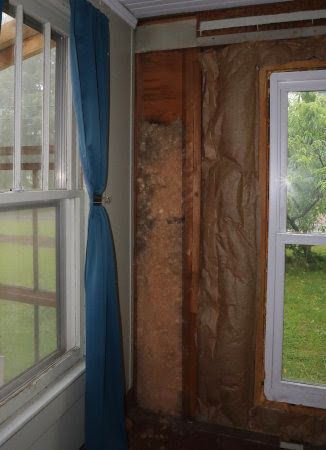
Energy leak at the top where the insulation had settled.

We didn't want to buy an entire new roll of insulation just to cut off a small narrow strip, so Dan filled the gap with a scrap piece of 2-inch form board. 

The foam board was leftover from our pantry upgrade.

Then the new plywood wall.

Ready for trim and paint.

I'll wait to do the painting until after Dan's done with his part. Baseboards and electrical wiring are in this next post, Sewing Room: Electrical Outlets and Baseboards

May 2, 2023

Sewing Room?

Last winter's sort, purge, and organize project turned out to be more successful than I expected. I focused on the two rooms we use for storage as we slowly continue working on the house. Not surprisingly, these have become chaotic catch-alls because, well, out of sight - out of mind. Dan moved all of the construction related stuff to the workshop, and I was able to significantly pare down the number of boxes we had. The remaining boxes are mostly weaving yarns, spinning fibers, sewing fabrics, and all of my knitting and sewing supplies. I was able to organize these in the front bedroom, leaving the other room clear and free. That room is the sun room (formerly my studio). 

The room has been like this since Dan replaced the old windows with a new one.
You can see the original windows plus other original photos of this room here.

The current state of the room is the result of upgrading the exterior of the house, i.e. new windows and siding. We left the interior for a future project.

There was originally a door here going out to the front porch.
We eliminated it when we put new siding on the porch walls.

You can't see it, but the greenhouse adjoins that left-hand wall on the outside.

I don't know why I never thought of it before, but as I looked at the newly reclaimed space I wondered if it could become a little sewing room. Actually, I do know why I never thought of it before. It's because I always imagined my studio to include not only sewing, spinning, and needlework, but also my loom and weaving supplies. It never occurred to me to simply set up a space dedicated to sewing and handwork—until now.

Renovating this room has been on the project list, but it's nowhere near the top. We have the greenhouse to finish (if it ever stops raining) and a masonry stove to build this summer. Plus, when Dan talks about finishing this room, he talks about gutting it and replacing ceiling, walls, and floor. But that would be a lengthy, major project, so I was perfectly happy with the idea of using the room as is, for now. I just want to use the space. When Dan took a look, he said at the very least, we ought to cover the exposed insulation. That, plus fresh paint on the ceiling and walls, and an area rug for the floor will give it a facelift. The major renovation can wait until some distant year in the future.

So that became our rainy day project. Next time, I'll show our progress so far. (Click here!)

Parting shot:

"May" from my cross-stitch calendar Christmas present.

Once I get my sewing room set up, I'll have my sewing, needlework, and knitting supplies organized and easily accessible. I'm looking forward to that!

April 28, 2023

Garden Notes: April 2023

Rainfall 

  • 1st: 0.375"
  • 7th: 0.25" 
  • 8th: 1.55"
  • 14th: 0.5" 
  • 16th: 0.2"
  • 22nd: 0.7"
  • 26th:  0.75"
  • 27th: 2.55"
  • 28th: 0.65"
  • 30th: 0.255"
  • Total: 7.75 inches

Temperature
  • range of nighttime lows: 36 to 66°F (2 to 19°C)
  • range of daytime highs: 47 to 84°F (8 to 29°C)

Weather Notes
  • We've had lovely temperatures for much of the month, but the wind has been brisk and cold.

Planted
  • buckwheat
  • corn (Trucker's Favorite)
  • sunflowers (Mammoth Russian)
  • tomato transplants (Black Krim and Celebrity)
  • Swiss chard (variety of seeds)
  • black turtle beans
  • amaranth (Golden Giant, or is it Giant Golden? I can never remember.)
  • cowpeas (Ozark Razorback)
  • cucumbers (landrace)
  • and

seed potatoes

The sprouted potatoes are from the pantry. The others I bought at my locally owned grocery store. They were only 39¢ per pound, so I was pleased to find them. When I checked out, the gal told me they were sent to them by mistake. Food delivery errors aren't returned, so they offered them for sale at an unusually good price. When I planted them, I augmented the soil with bone meal and azomite minerals, so I'm hoping they'll do well. 

Growing

potatoes

Edible pod peas. Can you see the first pod
in the lower right-hand corner of the photo?

pears

Sunchokes (Jersusalem artichokes)

Sweet potato slips

I don't have good windows for plants and plant starts, so I decided to try our bathroom window for starting some sweet potato slips. They seem happy there. I have three varieties: Vardamans, Georgia Jets, and a purple variety I got two years ago from Misfits. It's the purple that's produced all those sprouts. The Vardaman is finally putting out a few roots (no sprouts yet) and the Georgia Jet has done nothing. These produced well, although with lots of odd, lumpy shapes. They haven't stored well, however, so no great loss if they don't sprout.

Harvesting

handfuls of asparagus for snacks and salads

strawberries for our granola

fall planted lettuce

I planted a lot of lettuce last fall, but most of it didn't survive our cold winter. This one did though, and together with wild greens, offers us delicious salads. 

spring planted radishes

volunteer lambs quarter

First harvests of lambs quarter are for steamed or sauteed greens. I've got plenty volunteering, however, and hope to can quite a few pints. It's our favorite winter green.

As you can see, our gardening season is off to a good start! May promises to be just as busy, and hopefully, we'll have a good harvest season.

Your turn. How does your garden fare?