April 9, 2023

Another Experiment in Threshing Wheat

Wheat harvest is in June, and we try to get it threshed and winnowed as quickly as possible. It's much easier to store as grain than in a bulky, non-threshed form (easier to protect from moths, too). In the past, both Dan and I worked on this together, but last year, I had an abundance of tomatoes, figs, and pears, so that I didn't have time to spare for the wheat. The other day, I got out the last of the wheat heads and thought about how to thresh it.

Some of our unthreshed wheat from last summer.

 Of growing wheat, I'd have to say that the growing is the easiest part. Scything isn't too bad, or last year, we had a small enough patch that we could just cut off the heads with a hand sickle. The hardest part is the threshing, which is separating the grains from the seed heads. Winnowing is just tedious.

To thresh, we've tried stomping, pounding, flailing, and rubbing. Dan even tried converting a little yard chipper into a thresher (pictures and explanation here.) Even so, every year we're still looking for an easier way to do it. 

And that's where my experiment came in. 
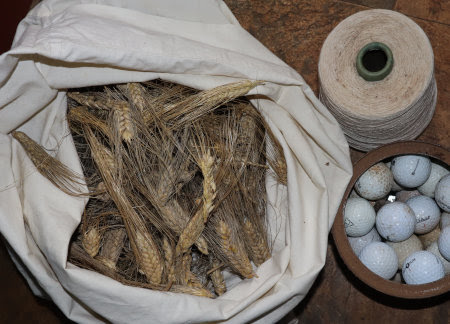

I filled a couple of pillowcases about a third full with wheat heads, added half-a-dozen golf balls, knotted the pillowcases closed, and tied them off with string for good measure. Then I put the bags into the clothes dryer.

I turned the heat off and set the dryer to the longest timer setting, which was 70 minutes. Then I let the bags of wheat bounce around in the dryer until the timer went off. Here's what it looked like when I dumped it out.


It worked!


I think this is the most thorough separation of wheat from the chaff we've ever had. And it required very little effort on our part! This method is a keeper! Now, I'm wondering how it would work for oats and buckwheat.

There are two caveats that I want to mention. The first is the type of fabric the pillowcase is made of. For my first load, I used one cotton pillowcase and the other polyester. When I dumped out the threshed wheat, the polyester pillowcase had chaff and wheat beards stuck all over it. It was a mess. The contents in the cotton pillowcase, however, dumped out cleanly and nothing stuck to the cloth. For my second load, I used only cotton pillowcases.

The second noteworthy point is that tying off the bags is a must. In the second batch, we tried leaving one bag knotted but not tied with string. Bouncing around in the dryer for over an hour managed to work the knot loose and much of the contents spilled out into the dryer drum. 

Next, I have to finish winnowing. No shortcuts for that, unfortunately. I'll just have to find the time to work it into my increasingly busy spring schedule.

April 5, 2023

First Turkey Egg

In Around the Homestead post, I mentioned that our turkeys hadn't started laying yet. Today, only a couple of days later, I'm excited to announce. . . 

Our very first turkey egg.

Our turkey hens are ten months old, so it's about time!

From the left: duck egg, chicken egg, and turkey egg.

The next day, we got our second. We have three turkey hens, so I'm assuming they'll all be laying soon. After we get a few more, we'll give them a try.

That's it for today. Such a small thing to be news I want to share. As I give this draft a last minute check as a preview, I stop at the word I chose to describe this event - exciting. I wonder how many people would see this word as an actual description? Or see it as simply filler for the sentence. I wonder, in a world now filled with non-stop controversial events, how many people see something as ordinary as a bird laying a first egg as exciting? Maybe it would be exciting if it was the world's first cloned egg. Certainly, there are few like myself, who aren't obsessed with a fascination for technology and its hoped for potential to change the evolution of our planet. I wonder, why that doesn't interest me? Why is my way of listening to the news more interesting to me than theirs? Then I shrug and decide I don't mind being left behind. 

Turkeys are seasonal layers and this is the season for nesting. So, of course we're wondering if any of our hens will go broody. Time will tell.

First Turkey Egg © April 2023 by Leigh

April 1, 2023

Around the Homestead

April, from my cross-stitch calendar Christmas present. :)

April is a significant month on the homestead. Our last projected frost date is mid-month, so we can start planting the summer garden. It's the month when the trees wake up from their winter sleep and put out new leaves. Warmer days and nights also mean that April is the month of our last fire in the woodstove. If we're lucky, mild days will continue and it won't get too hot, too soon!

With shifting priorities, my winter projects are mostly set aside. My clean and purge project went fairly well, and I made a lot of progress. I still want to organize my boxes of fabrics and sewing supplies; they've needed to all be in one place for several years now.

Goats

Of the goats, Caroline's udder is much better. The congestion is mostly resolved, although that side still doesn't produce as much milk as the unaffected side. I still offer bottles to her little girls, even though they eat grass, grain, and hay now too.

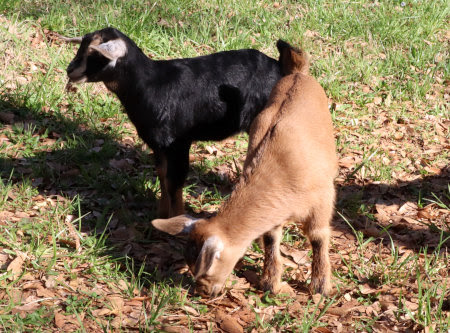
Caroline's girls have names now. The black is Jessamine, the brown is Charlotte.

Usually it's Charlotte, the brown doeling, who wants it. They each have their own side when they nurse, and she's the one who ended up with the side that was congested, so she's getting less milk than her sister. Goat mamas typically let their kids nurse anywhere from between four to six months. 

All three bucklings are sold and will be heading to new homes soon. They turned out really well. 

Mosul and his mom, River.

Orion

Originally Buster Brown, but 'Jupiter' for his registration papers.

The little bucks need to go first because they get, well, bucky by the time they are two months old. I like to give them at least 10 weeks of mom's milk, and then off they go. It's so much more peaceful to wean them by sending them to new homes, than having to separate them from their mothers. I still have to make some decisions about the little does, but I have more time for them.

Eggs

Chickens and ducks are laying well, but we have yet to get egg one from the turkeys. The other day, Dan found this tiny duck egg.


Crepe myrtle

Does anyone remember the crepe myrtle Dan dug up and dragged down to the woods? It was blocking sun on the greenhouse and needed to be removed.

Picture from Greenhouse Progress: A Side Project, Actually
There are more pictures at the link, for anyone who is curious.

We didn't know if it would survive, but guess what.

I don't think the log sections will tolerate kids jumping on them, so
I may encircle this with more clump grass to hopefully secure them.

The leaves around the base of the trunk are crepe myrtle sprouts. The leaves growing out the top are honeysuckle vines that were embedded in the the soil. 

Crepe myrtle and honeysuckle growing

Considering most of the feeder roots were chopped off when it was dug up, this is a surprise. If it can establish it's root system downwards, it will probably do well. Time will tell.

Firewood

Firewood for next winter curing

Ongoing Fence Maintenance

Willow inspects Dan's new fence bracing. The
old wood corner post had pretty much rotted away.

Plus

I want to mention that Permies' Master Gardener Program is finally finished and available. It may seem a little pricey, but it's 35 hours worth of Helen Atthowe's extensive better-than-organic video instruction, including veganic pest and disease management, and soil microscopy. If you've ever wanted to do a program like this and have anything left in your gardening budget, this is an excellent investment!