
 |
| Kinder buck |
I love my goats and one of the hardest things to do is to decide who stays and who goes. Unfortunately, this is a necessity because I only have so much room and so much pasture. That means I can't keep them all. Fortunately, I chose a breed that is in demand for homesteads and small farms, Kinders. They are mid-size and dual-purpose (milk and meat), making them a good option for a small operation.
Most of my surplus goats get sold. I don't make a profit, but this pays for feed and hay, which means my goats are self-supporting. Add milk, meat, manure, companionship, and endless entertainment, and I feel like I really come out ahead.
Does almost always sell because they are in higher demand than bucks. One buck can service a lot of does, so people keep more does. I do sell a lot of bucks and on occasion keep one. So what do I do with the ones I don't sell and don't necessarily want to keep? I could just keep them, and put a strain on our pasture and resources. Some folks do that. But I think the kindest thing to do is to humanly put them down and give them purpose after death, feeding others. The meat feeds us, the offal feeds pigs and chickens, the bones make nutritious broth and then feed the soil, and the hides can be tanned for leather. Finding purpose for every part of the animal is the responsible cycle of life.
When Dan butchers the meat for brining and freezing, he cuts off excess fat and I freeze it separately. Recently, I defrosted it and rendered it to tallow.

Rendering is the process of melting the fat, skimming off the bits of meat, and then pouring off the melted fat into storage containers to cool. From what I've read, the term lard refers to rendered pig fat, and tallow refers to the rendered fat of cows, sheep, and goats. Rendered chicken fat is called schmaltz. All of them are extremely important. They are used for cooking and soaps, and (once upon a time) tallow was also used to make candles.
The steps for making tallow (or lard) are easy: chop the fat into small pieces for quick melting, then put them in a large heavy-bottom pot with water covering the bottom.
 |
| Melting the fat. |
The water prevents burning and evaporates off as the fat simmers and melts. It's a slow, gentle process that requires frequent stirring.
Eventually, all that's left are the bits that don't melt. I transferred these to a cast iron skillet to finish browning them into cracklings.
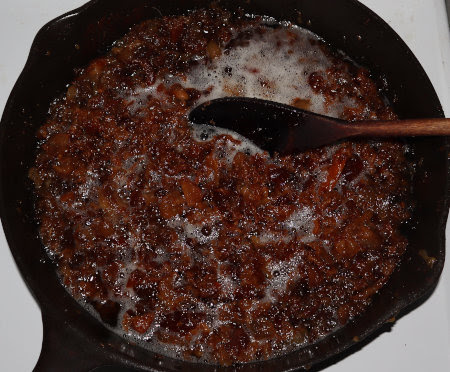 |
| Cracklings |
When nicely browned, I drain them and store them in another jar. We use the cracklings just like bacon bits! In fact, here's my recipe for Cracklin' Cornbread. They are also yummy in scrambled eggs.
 |
| Cracklings and leftover oven-baked french fries in scrambled eggs. |
Now, I'm guessing that folks who wrinkle their noses at cooking with animal fats have long since stopped reading this post. But if you haven't and are wondering how healthy they are, then I encourage you to read Sally Fallon's Nourishing Traditions. The science in that book completely changed my mind about the fats and oils we eat. The only oils I use now are extra virgin olive and coconut. For solid fats, I use butter, tallow, or lard. (Tallow and lard make the flakiest, melt-in-your-mouth pie crusts!)
My final yield from this project was 3 quarts of tallow, one quart of cracklings, and almost a pint more tallow from the cracklings.


