We took time our first years here for observation, analysis, and planning. At that time, we had three areas for self-reliance that we wanted develop: food, energy, and water. Water conservation and stewardship included rainwater collection and greywater usage. For rainwater, we started with collection tanks. For greywater, we added a couple of ideas to our master plan, where we identified two potential areas to use it.
Greywater is a topic we researched carefully because there are precautions that must be taken. We bought Art Ludwig's Create an Oasis With Greywater (my book review here), and I researched dos and don'ts for household soaps, detergents, and cleaners (that blog post here.) We experimented some too, and used it to water tall plants like okra and corn. From those experiments, we felt that some sort of filtration would work best for us.
When the summer rains became less frequent this month we got to talking about this. We got out our master plan (above) and discussed how we could construct a greywater wetland. Originally, the wetland idea was for a constructed filtration bed with rock, gravel, sand, and soil, plus water filtering plants. From there, it would drain out to the pasture. This would have required a lot of work, but we don't have the time or resources for an extensive project right now. Another commonly used idea for greywater, is a mulch pit. We got to wondering if we couldn't mulch pit that drained into our pasture swale. It would be a first step experiment, just to see how it would do.
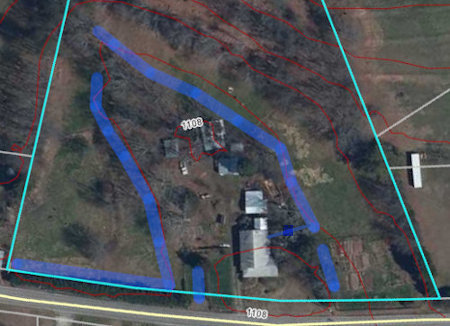 |
This is how it fits into our swale plan. The filtration bed is the
little blue square between the house and pasture on the right. |
The greywater drainage pipe was already in place. Dan installed it in 2016, complete with a bypass valve to direct the greywater either to the garden or to the septic tank. We haven't used it in several years, but this summer seemed the time to put it to use again. We brainstormed. For the mulch bed, we had a cracked water tote with five good sides. Dan cut it down and that made a start.
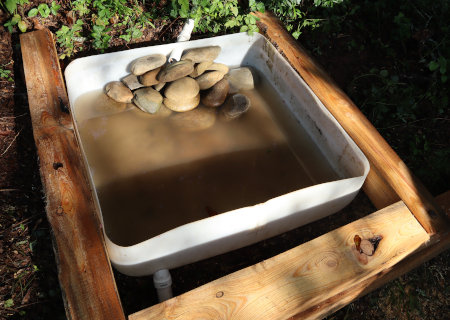 |
| Filled with rain water! |
He cut the existing drainage pipe and routed it through inlet and outlet holes cut into the tote. Because the cut tote walls aren't sturdy, he framed it out with some of his
home-sawn lumber.
Our mulch medium is woodchips,
because we make our own. To keep them out of the pipe, he used stone at the inlet, and screen at the outlet. The entire thing was then filled with woodchips.
 |
Completed project. You can see the greywater pipe coming from
the kitchen, and the mostly buried exit pipe going to the pasture. |
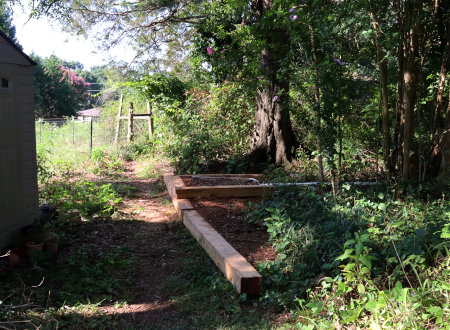 |
| View from another angle. The path leads to the garden. |
Periodically, this will need to be cleaned out and fresh chips added. The old chips will get mixed into a new compost pile, and the bed refilled with fresh chips, or even better, a combination of wood chips and biochar.
For now, we observe and take notes. We're already conservative with our water usage, and so far, the cut-down tote easily accommodates the amount. There are no large amounts of water entering the swale, but if we see puddles, we use a shovel to shape the drainage path to the swale (we knew it wasn't level and would need to do this). Mostly, the water is absorbing quickly, slowly hydrating the ground as it makes its way to the swale. There is no odor and no debris in the water. It isn't potable, but it looks clear.
Eventually, the filtration bed could be expanded to a larger, more complex system incorporating plants. That will probably depend on how well this one handles the amount of greywater we produce and how long it takes for this one to need a change of woodchips. I'm glad we started with a smaller version of our original plan. That will make it easier to make adjustments as needed.