When I wrote Prepper's Livestock Handbook, I researched off-grid meat preservation methods and came up with quite a few. What surprises me now, is that I didn't think of pemmican. Pemmican is one of those things I recall reading about in grammar school history lessons about Native Americans and the early English and French explorers. I'm not sure why it didn't come to mind when I did my research for that book.
I was reminded of pemmican when I was watching videos to pass the time while I shelled pole bean and turnip seeds for next year's garden. I subscribe to two historical cooking YouTube channels, and I ran across pemmican videos on both. Off-grid food preservation interests to me, so I did a little more research and decided to give it a try.
What is pemmican? It's a historical staple food of the Indigenous peoples of North America. Basically, it's dried meat, traditionally made from buffalo bison or venison. After it's dried (typically by the sun or campfire), it's powdered and mixed with melted suet or tallow. Sometimes, it contains
dried fruit, but sometimes not. During WWI, the Norwegian army produced a version containing dried vegetables. Most importantly, it's shelf stable, which means it doesn't
require refrigeration for storage. That makes it ideal for long
trips, when hunting or stopping at the convenience store isn't possible. It's a concentrated source of protein and
calories, and because it's fully cooked, it can be eaten as is (which is why
it's often thought of as a survival food), or as an ingredient in soup, stew,
or hash.
The ingredients are simple: lean raw meat and suet or tallow. Since dried fruit is optional, I opted for a plain version. Here's the process in pictures.

|
| Lean, top round beef roast. It weighed 2.42 pounds. |

|
| Cut cross grain into thin strips for dehydrating. No seasoning added. |

|
|
Dried crisp, which took about 12 hours in the dehydrator. The dried weight was 0.75 pound. |
Pemmican is different from jerky in several ways. One is that it is cut cross grain instead of with the grain. Jerky is highly seasoned and dried until it's pliable. Pemmican is not seasoned and is dried until crisp.

|
|
Cutting cross grain meant it was easy to snap into pieces for the next step. Here it is in my power blender, ready to ground fine. |

|
| Meat "powder." (Actually, more like very tiny fine shreds.) |
If suet is used, it needs to be rendered, i.e. melted to remove non-fat bits. If it's made from pig fat it's called lard. If it's made from cow, sheep, or goat, it's called tallow. My blog post on rendering tallow is here. Since I already had it, I just had to melt it to mix with the finely ground dried meat.

|
|
Melted tallow is added to bind the meat powder together. The amount is roughly the same weight as the meat or less. I used my goat tallow. |

|
|
It needs enough tallow to hold together without being overly greasy. Gloves were recommended for easier hand clean-up. |

|
| Pressed into a mold and allowed to cool. |

|
| Turned out of the bread pan mold after a night in my unheated pantry. |

|
|
Mine was crumbly when sliced. I'm guessing this means it could have used more tallow. |
Of course, we sampled it, and it wasn't what I expected. I watched a number of prepper videos where they sample it and think it's extremely bland and tasteless. Nobody seemed to care for it much and thought it's best use was for survival food. Dan and I thought it just tasted like beef. Not terribly greasy, and it could have used some salt, but the flavor was fine.

|
|
I packed most of it into wide-mouth pint canning jars and then vacuum sealed them. |
So, what will I do with it? Modern thinking classifies pemmican as a survival food, to eat as-is in a bug-out or emergency situation when one is unable to cook. For that, I think the addition of powdered dried fruit would help, not only for flavor, but to provide much needed carbohydrates. Historically, however, pemmican making was a food preservation method, and it was cooked, or used as an ingredient. As an ingredient, I found two recipes for it: rubaboo and rousseau (or rechaud).
Traditionally, pemmican was stored in skins rather than molded as most modern instructions call for (because how many of us have a few storage skins handy?) For my second batch, I added salt (1/4 tsp. per 1/4 pound dried meat) and packed it directly into pint canning jars.
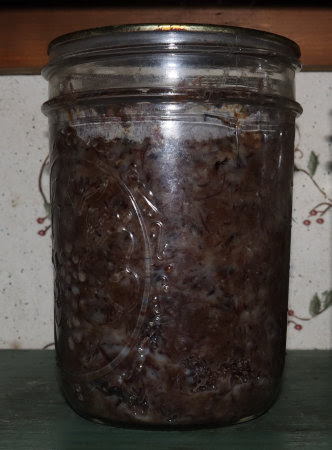 |
| 1/2 lb dried meat + tallow = roughly one pint of pemmican |
I can scoop out what I need when I use it.
When we taste tested this batch, we thought that the salt ratio of 1/4 tsp. salt to 1/4 pound dried meat was perfect.
Next time, I'll share how I made rubaboo and what we thought of it. (Click here for that blog post).
Resources:
- Pemmican: History's Power Bar - Tasting History with Max Miller
- Pemmican playlist by The Townsends
- Making Pemmican: The Ultimate Survival Food - 2 Guys and a Cooler
- The Pemmican Manual by Lex Rooker (a free PDF to download)