Showing posts with label potatoes. Show all posts

July 30, 2024

Garden Notes: July 2024

Rainfall

  • 7th: 1.27"
  • 16th: 0.03"
  • 18th: 0.48"
  • 19th: 0.51"
  • 20th: 0.03"
  • 21st: 0.47"
  • 23rd: 0.14"
  • 24th: 0.14"
  • 25th: 0.35"
  • 28th: 0.11"
  • 29th: 1.03"
  • 30th: 0.04"
  • Total: 4.6 inches
Temperature
  • range of nighttime lows: 64 to 73°F (18 to 23°C)
  • range of daytime highs: 82 to 95°F (27.7 to 35°C)
  • greenhouse, with the shade cloth: never got over 90°F (32°C)
Weather Notes
  • The month started off like a typical July with highs in the mid-90s F (low 30s C). The nights were unusually cool, though, with frequent overnight lows in the 60s F (upper teens C). 
  • Then the rain moved in and the daytime temps dropped 10 degrees for the remainder of the month. Nighttime temps remained cool. All welcome!
Planted: 
  • last of the sprouting sweet potatoes from the pantry
Harvested
  • slicing tomatoes
  • cherry tomatoes
  • green beans
  • blueberries
  • lambs quarter
  • daikon greens
  • summer potatoes
  • rugosa rose hips
  • oregano
  • basil
  • thyme
  • rosemary
  • wheat
  • buckwheat
  • okra
  • peaches
  • pears
  • peppers
  • black turtle beans
  • cucumber
  • walking onions
Preserved
  • blueberries, frozen
  • wheat, frozen
  • lambs quarter, canned
  • rose hips, dehydrated
  • pizza sauce, canned
  • goat mozzarella, frozen
Photos

daily picking bucket

harvesting the summer potatoes

air fryer roasted potatoes, okra, and walking onions

blueberries (from the big bush in the pasture hedgerow)

blueberry pie

tomatoes

Tomatoes we don't eat fresh go into the power blender
with herbs, onion, & green pepper for pizza/spaghetti sauce.

Then all I have to do is bring it to a boil for canning, add salt, and process.

pizza sauce, season's first jars

July salad: cherry tomatoes, lambs quarter, and goat feta

lambs quarter sauteed with carrots and onions

Last but not least . . .

Our original African keyhole garden with sweet potatoes and Egyptian walking
onions. 4 o'clocks are to the left, and our front yard blueberry bushes are behind.

That's it for my garden. How is yours doing?

December 27, 2023

Garden Notes: December 2023

   Rainfall 

  • 1st: 0.3"
  • 2nd: 0.4"
  • 3rd: 0.02"
  • 9th: 1.33"
  • 10th: 1.08"
  • 17th: 0.17"
  • 25th: 1.9"
  • 26th: 2.01"
  • 27th: 0.03"
  • Total: 7.24 inches
Temperature
  • range of nighttime lows: 21 to 58°F (-6 to 14°C)
  • range of daytime highs: 45 to 67°F (7 to 19.5°C)
Garden Notes:
  • I have a few things growing in the garden: kale, daikons, turnips, and Swiss chard.
  • Continuing to finish up mulching the remaining beds.
  • Then I'll start on tidying up and re-mulching the aisles.
Greenhouse Notes
  • Everything is doing well so far, although slow to grow.
  • Our coldest night so far this month was 21°F (-6°C), but the greenhouse didn't get below 32°F (0°C). My cherry tomato plant is still alive and well. 
  • As are my transplanted green pepper plants.
  • Once the sun hits the greenhouse, it warms up quickly, so I have to keep an eye on the temp and turn on the vent fan if needed. 

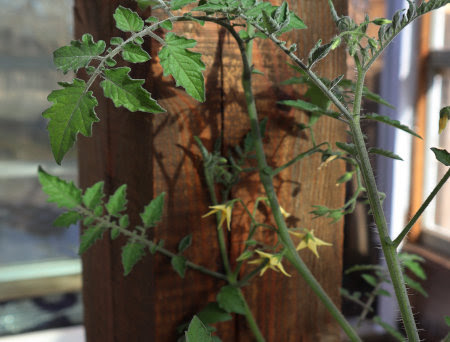
cherry tomato vine with quite a few flowers

sweet pepper plant

kale

broccoli

Planted (in the greenhouse)

celery base (from Thanksgiving stuffing)

sprouting garden potatoes from the pantry

The potatoes are an experiment. Potatoes are typically planted around here in March, which doesn't make sense to me because a frost or freeze will kill the top growth. Depending on what the rest of the winter is like, these may do okay for a few early potatoes.

Parting Shot

December salad: daikon leaves, kale, Swiss chard, chickweed,
dandelion leaves, feta goat cheese, & greenhouse cherry tomatoes.

July 28, 2023

Garden Notes: July 2023

 Rainfall 

  • 1st: 0.48"
  • 2nd: 0.25" 
  • 4th: 0.47"
  • 6th: 0.03"
  • 7th: 0.44"
  • 8th: 0.01"
  • 10th: 0.03"
  • 15th: 0.17"
  • 19th: 0.17"
  • 20th: 0.18"
  • 22nd: 0.37"
  • 28th: 0.69"
  • 31st: 0.39"
  • Total: 3.68 inches

Temperature
  • range of nighttime lows: 63 to 73°F (17 to 23°C)
  • range of daytime highs: 80 to 93°F (26 to 34°C)

Weather Notes
  • Firstly, I'll make note of my Thermometer Discrepancies post plus comments. I'm still mulling over exactly what data is useful to me in our lives here: rainfall surely, temperature logical, with humidity and heat index a large factor which only seems important on the day. I'm jotting the heat index down on my calendar, but I'm not sure what else to do with it yet.
  • The highs have been on the low side of normal for July, but it's been humid, which means we're just as hot and sticky as when they're on the high side of normal!
  • The lows are unusual. Typically, this time of year our lows our in the mid-70s (   ), so we're cooling off at night more that usual. This is welcome! It helps cool the house off. We haven't had to use our Arc-Chill cooling blanket yet, and I often put on a flannel shirt when I head out for early morning chores. 
  • Rain forecast is always for "scattered thunderstorms" or "isolated showers," which means sometimes we get it, sometimes folks down the road get it. (Which can be frustrating for a gardener.) I think the frequent cloudy days are what's helped keep our daytime highs lower than usual.

Garden Notes
  • Only mornings are cool enough to be in the garden, but our humidity is in the mid-90s%, which means everything is drenched with dew. I have to get everything done by 9 or 9:30, when the sun hits the garden. It's just too hot after that.
  • Afternoons are for canning or other activities.
  • Morning garden work includes picking, bed prep (like the potato beds, which are all done for the summer), some weeding, and I still have a few places to mulch.
  • This time of year, the garden is on the wild side.

Believe it or not, everything here is stuff I want: summer veggies, volunteers,
forage greens, and cool weather crops going to seed, which I'll collect later.

Photos

The final load of potatoes, with one lone onion I found.

Final harvest weight  of potatoes was close to 80 pounds. We've had a lot of discouraging years with them, but this year they did well. I think the difference was preparing the bed with compost, bone meal, and azomite minerals. Last year I reviewed a book by Lynn Gillespie, High Performance Gardening. It's primarily a beginning gardener's book, but I gleaned a nugget of gold in her discussion of soil minerals. I did a little research and discovered that I already had a good solution in the barn, Azomite. It's powdered organic trace minerals, and I started mixing small amounts with my compost. I think that's what made the difference!

The other thing I want to note is that digging potatoes was easy this year. I planted the seed potatoes in shallow soil and then mulched heavily. All potatoes were right under the surface of the soil and easy to find. Very little actual digging required.

Early July harvest sampler: summer squash, slicing tomatoes, cucumbers

Okra and cherry tomatoes followed soon afterward.

It's too hot for lettuce, so our July salads are usually cucumber and tomato based,
maybe with hardboiled duck egg, grated feta goat cheese, and ricotta/salsa dressing.

Or this one: tomato, cucumber, and black olives as a
treat. The dressing is my homemade ricotta ranch.

July canning sampler: pear sauce, zucchini, dill pickles

I'm guessing August will be hotter and dryer. August is when it's recommended to plant my fall veggies, but it's usually too hot and dry for that to make sense. 

How is everyone else doing? Gardens still making it? Not overworking? Anybody else looking forward to fall?

November 5, 2022

Silicone Dehydrator Tray Liners

One of my learning projects this year has been learning how to make fruit and vegetable powders (like dried pear sauce and powdered tomatoes). The problem is that dehydrator trays are mesh. That works great for solid slices and pieces, but not so well for sauces and purees. I've tried both waxed and parchment paper, but they tend to stick to the food and need careful peeling off. This is a tedious extra step, so I finally decided to invest in some silicone tray liners for my dehydrator. The Excalibur brand is pretty expensive, but I bought some from Amazon for about $18 for a four-pack. 


They fit my Excalibur trays perfectly. I tested them out with more mashed potatoes for homemade instant mashed potatoes.


I really like that these have a rim on them. It made it easy to spread the pureed potatoes evenly.

When I checked on it after several hours, the top was dry but the underside was still wet. So I flipped the sheets of potatoes and dried them for several hours more.


The sheet of potatoes shrank, as dehydrated foods do, and the edges curled. But they didn't stick to the silicone tray liner! 

I broke them into chunks, powdered them in my blender, and transferred them to a storage jar.

I think this was a useful purchase for me because, unlike waxed or parchment paper, these are reusable, plus save frustration. I've slowly learned that not all purchases actually end up being useful, no matter how appealing the item was at the time. Learning to not succumb to impulse purchases has really helped in that department! A thoughtful purchase, on the other hand, is well worth it, even if the item is used only rarely. I don't mind putting time into any project, but being efficient with that time is important too.

October 7, 2022

Dehydrated Potatoes For Instant Mashed

I grew up in meat and potato country, where potatoes were the standard starch for most meals: baked, mashed, boiled, scalloped, hashed, french fried, you name it, we ate potatoes that way. Now, I rotate the starches I serve—rice, pasta, potatoes, bread or rolls—but our favorite is always potatoes. Especially, mashed. With salt and butter. Or gravy.  Or my mock sour cream (ricotta with a little kefir stirred in until it's sour cream consistency). Yum. 

There are a lot of steps to making mashed potatoes, however, so I don't make them very often. There's store-bought instant, but somehow I don't think those taste very good. They supposedly use freeze drying to make it (which is said to be superior for retaining flavor and nutritional value), so maybe it's the other stuff they put in it: vegetable oil (soybean, cottonseed, sunflower or canola), corn syrup solids, maltodextrin, sodium caseinate, disodium phosphate, mono and diglycerides, calcium stearoyl lactylate, artificial flavors, artificial color, sodium acid pyrophosphate, sodium bisulfite, dipotassium phosphate, silicon dioxide, etc. Or maybe because I'm so used to eating real food, that store bought instant mashed potatoes just taste "off."

When I discovered several mashed potatoes dehydrating videos, I was interested! They were pretty easy to make.

Cut into chunks and boil as for mashed potatoes.

Mash when soft. Don't add milk or butter. If it 
needs thinning, use the potato boiling water.

As you can see, I didn't peel my potatoes, even when I'm mashing them. It adds nutrition, and neither of us minds the bits of peel. We're used to it.

Spread onto fruit leather trays or parchment paper. Set the dehydrator
to the vegetable setting and dry until crisp (for me, about 18 hrs)

I've tried both waxed paper and parchment paper for drying things like this. I don't find either works very well, so I'm thinking I need to invest in some fruit leather tray liners or maybe silicone baking sheets. (Which I did and they work great! My review is here.)

Break into pieces and put them into the blender.

Blend on high until it's powdered!

Store in a sealed, airtight jar (I vacuum pack mine).

I haven't tried making mashed potatoes with them yet, but I'll report back when I do. I'm going to follow the rehydrating recipe from Northstar Prepsteader.     

Heat to boiling
2/3 C water
1 T butter
1/4 tsp salt
Remove from heat and stir in
1/4 C milk
2/3 C potato flakes
Season to taste 

If these are as good as everybody says they are, we'll eat a lot more mashed potatoes this winter!

May 16, 2022

Spring Planting & Growing: Late Edition

Spring's last anticipated frost date divides my planting season into early and late. If the weather turns warm early, I'm always tempted to take a chance and plant early. Last year I did that and we had a late frost. This year I waited. I'm glad I did because we had another late frost this year! We're on the other side of that now, so we're busy planting and transplanting warm weather veggies and crops.

Warm season seeds planted so far:
  • cantaloupe (Hales' Best)
  • cowpeas (Ozark Razorback)
  • okra (Clemson spineless)
  • peanuts (a Virginia type, I think)
  • my landrace cucumbers (F1)
  • calendula
  • sunflowers
  • corn (Painted Mountain)
  • winter squash (Sweet Potato)
  • summer squash (White Scallop)
  • Swiss chard
    • Fordhook
    • Rugy
    • Rainbow blend
  • sunflowers (Russian Mammoth)
  • dill
  • marigolds
  • scarlet runner beans

Plants planted or transplanted:
  • asparagus roots
  • sweet potato slips (Georgia Jet)
  • tomato plants
    • Matt's Wild Cherry (volunteers)
    • Better Boy
  • table grape (green seedless)
  • olive tree (Arbequina, supposedly okay for my growing zone)
  • redbud seedlings

Working on:
  • pasture

Still to plant:
  • green beans (Cornfield, when the corn is about 6" tall)
  • more summer squash & cukes (for extended harvesting)
  • more herbs (hopefully)
  • purple sweet potato slips

Purple sweet potato sprouts for slips

 I got the purple sweet potatoes from Misfits Market. They were excellent keepers and very tasty, so I saved one to sprout for slips. It's been slow, I reckon because it's been a fairly cool spring. Eventually I'll get them in the ground to grow my own.

Harvesting:

Snowpeas

Asparagus

Garlic

Lettuce

Strawberries

Red raspberry leaves to dry for tea

Mizuna

Peppermint for tea

Oregano for seasoning

Waiting to harvest:

Potatoes

Wheat

Multiplier onions

And of course, we're waiting on everything else! The challenge, now, is getting enough rain. We had a very rainy spring but no rain since our last frost, except for an occasional drizzle. Without moisture, things don't germinate or grow, so I'm doing a lot of watering of transplants and baby plants. We're really enjoying the lettuce and snow peas, and I'm hoping with plenty of watering they'll continue to produce. But I hesitate to water newly planted seeds, wondering if it isn't better to wait until it rains for nature to take it's course.

The transition from rainy to not-so-much rain pretty much marks our transition from spring to summer. That, and the days are getting hot. Those days are upon us, so it's definitely time to finish planting and shift seasonal gears.

April 9, 2022

Spring Planting & Growing: Early Edition

"All spring, I try to plant something every day "
Carla Emery, Encyclopedia of Country Living

I love that quote by Carla Emery, but I confess I haven't faithfully applied it this year. We've had a lot of rain, so some days it's too muddy to work in the garden. I managed to get my cool weather crops in, and now look forward to our last potential frost date. That date falls in the middle of our spring planting months, and so divides my planting season into early and late.

Planted so far:
  • turnips
  • kale
  • carrots
  • parsnips
  • mangels
  • sprouted pantry potatoes
  • beets
  • lettuce
  • snow peas
  • salsify
  • pink dandelion
  • cultivated burdock
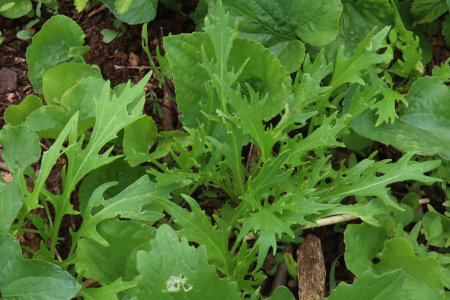
  • mizuna
  • bloody dock

Of the root crops, only the mangels and burdock have emerged so far. You'll see them with the other spring garden photos below.

I only had a few plants survive winter; the rest succumbed to the cold.

These collard plants are several years old. I don't get huge
leaves from them anymore, but the small ones are tasty too.

One of just a few fall planted kale plants that made it.

Fall planted garlic, multiplier onions, and volunteer potato
plant (the sprouted pantry potatoes haven't emerged yet.)

More garlic

The one that concerns me is our wheat. It's yellowing.

Our fall planted wheat. Yellow from ???

There are a number of things that can cause this: nitrogen deficiency, iron deficiency, sulfur deficiency, fertilizer burn, herbicide injury, moisture stress, plus disease or insect damage. Apparently it's common enough that there are scores of articles written about it and speculating as to its cause. 

We don't use fertilizer, herbicides, or pesticides, so those are out as causes. Nutrient deficiency perhaps. Dan side dressed the rows with compost to see if it helps. Moisture stress is a possibility. Not from too little rain, but because we've had so much. At any rate, it looks like we'll still get a harvest.

It's still going to seed.

Saving for next year's seed will be the priority. We can always adjust our diet to whatever's left over if we need to.

Next are the early spring planted veggies.

Snow peas. No flowers yet!

Lettuce and volunteer dandelion; both salad favorites.

Mangels. These make great livestock feed (both leaves and roots).

Mizuna and violets (of which the flowers are edible)

Now that the swale is in and working well, I'm hoping my hoop house will be more useful in summer. Its raised beds dry out quickly in summer, so that I tend to plant there as a last resort. What I've decided to use them for is perennials, where the raised bordered beds can keep them under control.

Cultivated burdock and volunteer chickweed.

The other thing I planted this spring was the garden swale berm.

Swale berm planted with herbs and edibles.

I made a seed mix of all my old herb, flower, greens, and root crop seeds plus clover. Then I covered it with compost. Because the berm is sloped, much of the seed has washed down a bit, but hopefully enough has stayed put to help anchor the soil. It will be fun to see what grows.
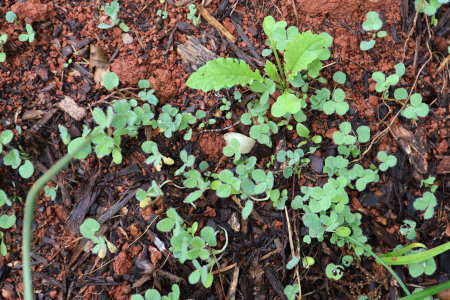
Seed mix sprouting on the swale berm.

Then there are the perennials.

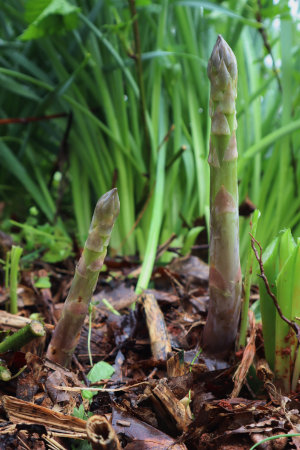
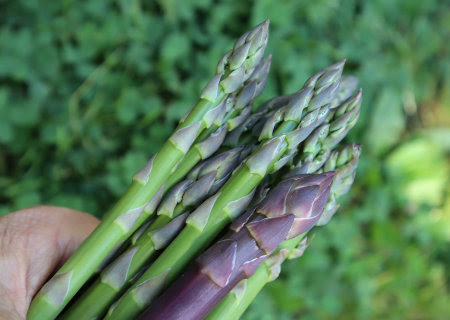
My few asparagus plants were taken over by
blackberries and daffodils, so I liberated them.

I actually gave up on asparagus a long time ago, because the wiregrass kept choking it out. But I have four or five plants that have hung in there over the years. We only get a few stalks at a time and enjoy them greatly, so I think it's time to invest in more.
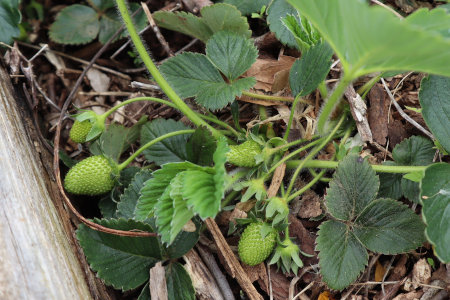
Strawberries are thriving. My competition for those is slugs, birds, and chipmunks.

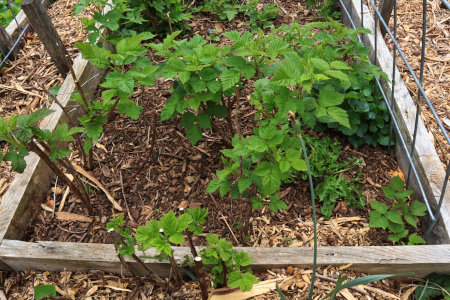
Red raspberries are leafing out.

Horseradish. Young leaves are good in a steamed greens mix.

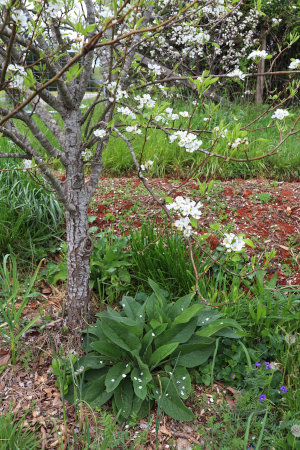
Pear tree, garlic, & comfrey; swale berm in the background.

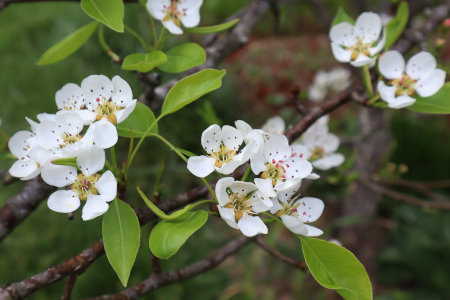
Pear blossoms. Pears seem to be our most reliable tree fruit.

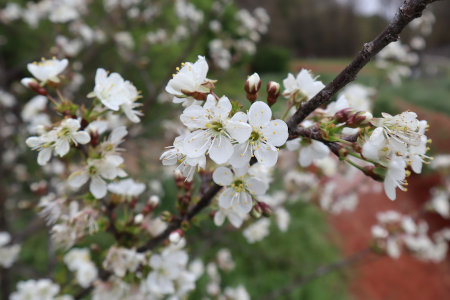
Cherry blossoms. If I can beat the birds to them, I might get some!

Our last expected frost date is right around the corner. Then we can get to work planting our warm weather favorites. Like every other gardener on the planet, I'm looking forward to that.

How about you? How does your garden grow?