August 29, 2022

Garden Notes: August 2022

 Rainfall

  • 1st: 0.35"
  • 3rd: 0.125"
  • 4th: 1"
  • 7th: 0.8"
  • 11th: 0.9"
  • 17th: 0.1"
  • 19th: 0.5"
  • 21st: 0.7"
  • 26th: 0.1"
  • Total: 4.575"

Temperature

  • nighttime range: 68-75°F (20-24°C)
  • daytime range: 78-94°F (25.5-34.5°C)

No complaints about August weather. We had good rainfall and generally cooler daily temperatures than July. We only saw 90s during the first and last weeks of the month. On the other hand, the higher humidity meant that it felt just as bad as the 90s! What really helps is when it gets down to below 70°F (21°C) at night because we can cool the house down, making it more tolerable during the day.

State of the garden

All I can say is, beauty is in the eye of the beholder. Everything is overgrown and runaway so that it looks a mess. But almost everything in it is useful!

Here we have cherry tomatoes, watermelon, mangels, horseradish,
celery, lambs quarter, sweet potatoes, raspberries, cowpeas, landrace 
brassicas, morning glory, a couple of carrots, and a potato plant or two.
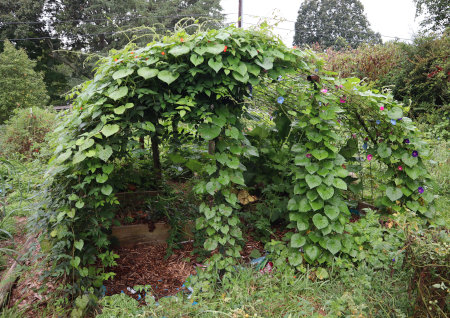
Hoophouse: The living shade you see is hopniss, cherry tomatoes, and morning glories.

Also a volunteer winter squash, cultivated grape, and Chinese yams.

My largest sweet potato squash so far.

Inside the hoophouse are winter squash, Malabar spinach, violets,
strawberries (back right bed) and cultivated burdock (back left bed.)

Hugelkultur: winter squash, turtle beans, cherry tomatoes,
chicory, clover, morning glories, lambs quarter, & sunchokes.

Hugelkultur closeup featuring squash and chicory.

African keyhole garden: sweet potatoes and a survivor kale.
The porch trellis is growing green beans and cherry tomatoes.

I planted kale in the keyhole bed about a year ago. This is one of
two plants that survived both our cold winter and hot summer.

Picking and Preserving

Bucket full of cherry tomatoes, a few okra, and one lone pepper.

The cherry tomatoes are still going gangbusters. I got bored with making and canning pizza sauce, so I'm switching to tomato juice and ketchup.

The cucumbers are done, so our salads, now, are cherry tomatoes and kale.
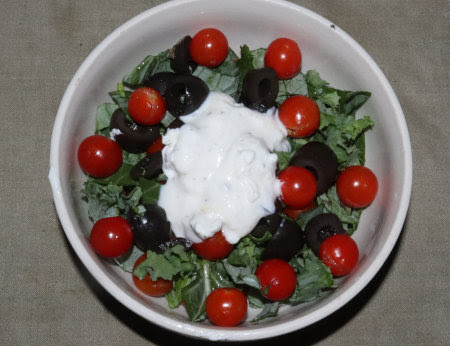
Tomato, kale, and black olive salad
with homemade ricotta ranch dressing.

The okra hasn't been very productive. 

Okra is a member of the hibiscus family.

I don't plant a lot, just enough to have oven-fried okra a couple times a week during growing season, with a little extra to freeze for a side dish during winter. It hasn't produced that much, although it's making a better effort now that our daily highs aren't so scorching and we're getting a little more rain.

August is fig month, and these are the largest figs we've ever seen on our trees.


They aren't all this size, but it's amazing to find them. Can't take any credit, though, because the fig trees are pretty much on their own! They are next to the goat barn, so perhaps they're getting some rich rain runoff.
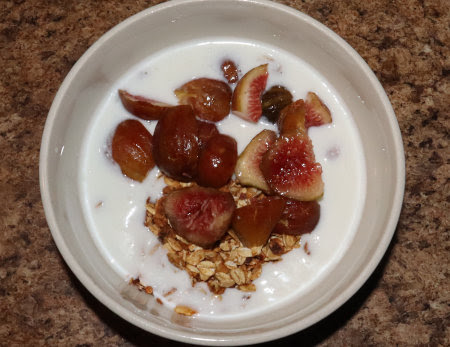
Breakfast: fresh figs on peanut butter granola with
kefir. Sometimes we swap the figs for diced pears.

There were lots to can.

And dessert!

Fresh fig cake with vanilla goat milk ice cream.

Pear harvest started in late July. The heaviest harvest was a couple weeks ago.

Bucket of pears.

One year, I spent days in the kitchen canning chunked pears, but Dan wasn't very enthusiastic about them. So now, I just make pear sauce. It's easier and faster to do, and we both like it.

Cinnamon pear sauce.

As pear picking slows and the pearsauce jars fill, I switch to drying them. Ditto for figs.
 
The cores and peels are being made into vinegar.

Elderberry harvest starts in late August.

First of the elderberries.

I used the first of them to flavor my canned figs and pearsauce. I also freeze them for jelly making this winter, and will make a couple batches of elderberry wine. This year I want to try an elderberry pear wine. I've experimented with adding other fruits for subtle flavor (of which some are more likable than others).

And a few parting shots.
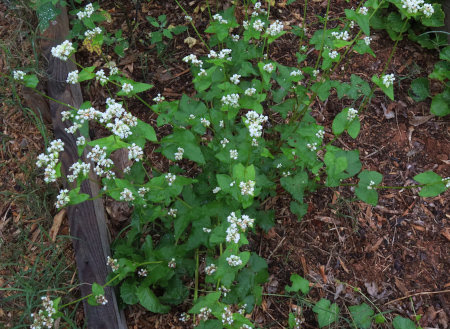
Buckwheat planted as a cover crop in my newest swale bed.
Only a few plants came up, so this will be my seed crop.

Marigolds and a winter squash blossom.

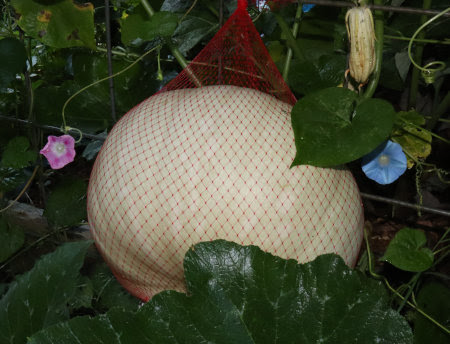
Our first Orange Glo watermelon of the summer.

I picked the watermelon just the other day. They were planted late, and only after my cantaloupe plants all died. I'm not sure what happened to them. They were doing well until our hot dry spell. I watered them faithfully, but they weren't happy and that was that. The watermelons have done much better and we're just starting to enjoy them.

So there are the pictures to go along with my Summer Mantra blog post. I liked hearing about what you all have been up to in your gardens, so keep the comments coming. 😀

August 25, 2022

Summer Mantra

Pick, process, preserve
The mantra of my summer days is
Pick, process, preserve

While our August weather is signalling the approaching end of summer, the garden is not. Even heat loving vegetables don't like our intense southern summers. When it begins to cool down to the upper 80s°F (upper 20s°C), things tend to make a renewed effort at production. That means that picking, processing, and preserving are all still in high gear. With the goat kids now sold or weaned off their mothers, I have lots of milk to deal with too, which means cheese making season is in full swing.

Our day starts early. We eat breakfast before sunrise and get out to the barn as it's getting light. Dan tends to the poultry and feeds the bucks while I feed the does and do the milking. Once the dishes are done and the milk strained and refrigerated, I'm off to the garden with two buckets. I try to finish my picking by 9 a.m., because once the sun hits the garden in full force, it's too hot to enjoy it. The rest of the day is spent processing and preserving the mornings pickings for winter eating.

People tell me gardening and home food preservation are a lot of work. I calculate that during the months of July and August, I put in a good 40-hour week preserving our harvest and making cheese. That doesn't include regular critter chores, meal preparation, and an hour lunch break. I don't think that's too bad. And if I wasn't preserving our own food myself, I'd have to go work for someone else so I could buy all our food! Considering how prices keep going up and availability keeps going down (I almost dread going shopping nowadays!), I'm very happy to spend the time working for myself. It's a satisfying endeavor.

I think the key to not feeling overwhelmed is in coordinating my time. Some things, like figs, need to be canned as soon as possible after picking, but tomato sauce and pearsauce need slow cooking time. They don't demand constant stirring, just an occasional stir. For dehydrating, the produce must sliced or diced before going into the dehydrator, then there's a long wait time while it's drying. Cheese making too, needs time for the milk to culture and form curds. Pressing the cheese is another time chunk, and brining requires I keep track of the time. All of these jobs require keeping an eye on, but while I'm waiting for the next step, I can work on something else. 

How much to preserve is a concept that's evolved for me over the years. In the beginning, I did a lot of calculating. Then experience taught me that nothing about living, growing things is predictable. 


"Even though we're working toward year-round food production, I still preserve quite a bit. That hasn't changed, although I've given up on specific goals for food preservation.
 
'Initially, my method . . . was a pretty simple one. I considered how much of a particular food we eat each week, and then figured out how much we'd need on hand until next year's harvest.'
“Food Self-Sufficiency: Feeding Ourselves,”
5 Acres & A Dream The Book (p. 67)

Now, we eat our fill of fresh foods and the remainder are preserved. I may end up with more than I need for the upcoming winter, but if the next summer's yield is poor, I'll have extra for the following winter too. Between that and expanding our fall and winter garden, we have the best variety we are able."
“Food Self-Sufficiency: Feeding Ourselves,”
5 Acres & A Dream The Sequel
 
So, as long as the garden is producing, I'll keep on putting as much of it by as possible. It will slow down as soon as the pears are done, but I'll probably have tomatoes until we get a good frost. Some years I only get enough to make pizza sauce, but this year I'm able to do some other things like tomato ketchup and tomato juice. It's nice to see the pantry filling up again.

How about you? What have you been up to this summer?

August 21, 2022

Rendering Goat Tallow

Kinder buck

I love my goats and one of the hardest things to do is to decide who stays and who goes. Unfortunately, this is a necessity because I only have so much room and so much pasture. That means I can't keep them all. Fortunately, I chose a breed that is in demand for homesteads and small farms, Kinders. They are mid-size and dual-purpose (milk and meat), making them a good option for a small operation. 

Most of my surplus goats get sold. I don't make a profit, but this pays for feed and hay, which means my goats are self-supporting. Add milk, meat, manure, companionship, and endless entertainment, and I feel like I really come out ahead.

Does almost always sell because they are in higher demand than bucks. One buck can service a lot of does, so people keep more does. I do sell a lot of bucks and on occasion keep one. So what do I do with the ones I don't sell and don't necessarily want to keep? I could just keep them, and put a strain on our pasture and resources. Some folks do that. But I think the kindest thing to do is to humanly put them down and give them purpose after death, feeding others. The meat feeds us, the offal feeds pigs and chickens, the bones make nutritious broth and then feed the soil, and the hides can be tanned for leather. Finding purpose for every part of the animal is the responsible cycle of life.

When Dan butchers the meat for brining and freezing, he cuts off excess fat and I freeze it separately. Recently, I defrosted it and rendered it to tallow.

Rendering is the process of melting the fat, skimming off the bits of meat, and then pouring off the melted fat into storage containers to cool. From what I've read, the term lard refers to rendered pig fat, and tallow refers to the rendered fat of cows, sheep, and goats. Rendered chicken fat is called schmaltz. All of them are extremely important. They are used for cooking and soaps, and (once upon a time) tallow was also used to make candles.

The steps for making tallow (or lard) are easy: chop the fat into small pieces for quick melting, then put them in a large heavy-bottom pot with water covering the bottom.

Melting the fat.

The water prevents burning and evaporates off as the fat simmers and melts. It's a slow, gentle process that requires frequent stirring. 

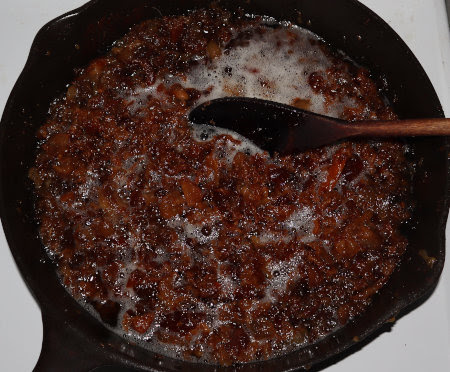
Eventually, all that's left are the bits that don't melt. I transferred these to a cast iron skillet to finish browning them into cracklings.

Cracklings

When nicely browned, I drain them and store them in another jar. We use the cracklings just like bacon bits! In fact, here's my recipe for Cracklin' Cornbread. They are also yummy in scrambled eggs.

Cracklings and leftover oven-baked french fries in scrambled eggs.

Now, I'm guessing that folks who wrinkle their noses at cooking with animal fats have long since stopped reading this post. But if you haven't and are wondering how healthy they are, then I encourage you to read Sally Fallon's Nourishing Traditions. The science in that book completely changed my mind about the fats and oils we eat. The only oils I use now are extra virgin olive and coconut. For solid fats, I use butter, tallow, or lard. (Tallow and lard make the flakiest, melt-in-your-mouth pie crusts!)

My final yield from this project was 3 quarts of tallow, one quart of cracklings, and almost a pint more tallow from the cracklings.


Rendering Goat Tallow © August 2022