July 30, 2018

Photo Wrap-Up for July

Lots of color in the front yard.
July color: echinacea and crepe myrtles.

July has been such a busy month that it seems I should be saying it's a relief it's nearly over. But August will be just as busy, as building, gardening, harvesting, preserving, and researching continue their fast and furious pace. The amazing thing about July was all the rainfall and cooler temperatures. "Cooler" is a relative term, of course, but the highs only got to about 90°F (32°C), many days cooler. That's ten degrees cooler than what we usually expect this time of year.

To close out the month, here are a few shots from my July photo folder.

Tomatoes are just starting to ripen and okra is going gang-busters.
Freshly picked okra and tomatoes

Small patch of Truckers Favorite corn in the garden.
Corn in the garden.

Cucumbers on cattle panel trellis.
Cucumbers in the garden.

Homegrown salad of cucumber, hard-boiled egg, and goat feta cheese.
Cucumbers in salad (with hard-boiled eggs and feta cheese)

July is blueberry time with pie to prove it.
Blueberries in pie. (That first fresh blueberry pie is always the best!)

One of my Kinder bucks
Hudson hoping for a treat of leafy blueberry branches.

My pears have done really well this year.
Harvested pears

First load of canned pears.
Canned pears

My first ever pear pie! Yummy!
Pied pears

Mother and daughter Kinder goats.
Iris and Jessie in the old goat barn. (Moving day approaches).

Muscovy Mama on the tree we need to cut up for firewood.

Figs are ripe early this year.
Fresh figs

First figs went into the freezer for jam making this winter.
Frozen figs

First time to try figs in pancakes. I'll do it again!
Figs in gingerbread pancakes

Love my Sun Oven.
Solar cooked comfort food at the end of a busy day.

Our best mouser.
Meowy at the end of a busy day.

Photo Wrap-Up for July © July 2018 by

July 27, 2018

Six Months Later: How Dan's Hand is Doing

It's been six months since Dan nearly cut his fingers off with the table saw. How is his hand?


That's the first picture I've ever taken of it. And even though it's not pretty, it looks a whole lot better than it did before.

He doesn't have much pain anymore, but the fingers are still pretty sensitive. The worst part is the stiffness. Most of the time those two fingers just won't bend. Now if he gets busy with a project and doesn't think about it, he can get some bending of the knuckles, but they tend to lock up again quickly which limits his dexterity and especially the ability to grasp. He massages it with healing oils and that helps some.

He's not one to let it get him down, however, and he's been able to compensate for most tasks and tools, except the chain saw. He needs to be able to grasp it properly to use it, which he can't do yet. He hates using the table saw (and probably always will!) but forces himself because, as he says, we've just got too much to do around here.

The trucking company he used to drive for said he could come back to work with doctor's permission. But because of his limitations, especially with grasping and holding, he doesn't think he could actually perform the tasks required for the job. So after a few lifestyle adjustments we're making do on Social Security retirement. We can pay our bills, buy necessities, and still have enough to slowly work on projects. Happily, my author's advance from Prepper's Livestock Handbook enabled us to buy most of what we need to finish the barn. Hopefully it will sell well and help us with tools and equipment we need to save up for.

So that's the Dan report. He sometimes feels like his hand is as good as it's going to get, but I say it's still healing and there's still hope. At least he's back to leading a relatively normal lifestyle.

July 24, 2018

Goat Barn and Garden: Killing Two Birds With One Stone

In my "Goat Barns: Delays and Discoveries" blog post, I showed you how Dan dealt with a massive amount of rain runoff that was finding it's way into the soon-to-be-completed goat barn. Subsequent rainfall proved its effectiveness, but Dan wasn't satisfied with this:

Drainage pipe in front of the goat barn to resolve rainwater runoff problems.

This is the drain pipe in back of the barn. It's protected by an overhang which will serve as the goats' loafing area. However, Dan wasn't sure the pipe was buried deep enough, considering that goats and us will be constantly walking over it. Probably wouldn't be a problem, but neither were we looking for a future "why didn't I ...?" moment.

So he dug it up and buried it deeper. Satisfied with that, he wanted to build up the ground on top of the pipe and gently slope it away from the barn. But with what? Folks used to give away fill dirt for free, but apparently not anymore. We really didn't want to buy dirt, so we brainstormed: Gravel? Sand? Concrete? We really didn't want to buy those either.

"How about clay?" I suggested, because our subsoil is southern red clay.
"But from where?" he asked.We'd have to dig at least 6 inches to get it.
"I've got just the place," I said, because I've been wanted to build more hugelkultur swales in the garden.

So far I've dug three swales in the garden. One at the top of the garden, and two that became beds. Plantings in those two beds have really done well during our dry spells and require less watering. My goal is to convert the entire garden to permanent raised hugelkultur swale beds.

Our brown sandy loam topsoil doesn't hold water, but our red clay subsoil does. With our garden is on a gentle slope, rain runs right through the topsoil, hits the clay, and drains out down the hill. By digging swales into the clay and filling them with organic matter, I can capture and retain some of that rainwater.

Why hugelkultur swales work for me.
Read more at, "Double Digging for Rainwater Collection."

When I dig the swales I save the topsoil to mix with compost, but I don't need all that clay. When Dan needed filler for the drainage pipe I thought the clay would be a good option. I had just the spot picked out.
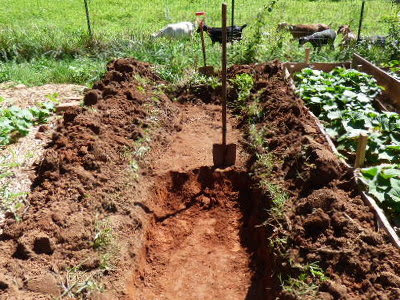
Double digging to create a hugelkultur swale.
Brown topsoil is about a shovel's spade deep, so I dug another
shovel depth into the clay to collect and hold rain runoff.


That's the earthworks part, the next step is the hugelkultur part. The bottom of the swale, the part dug in the clay, is filled with anything that will hold moisture and decompose slowly: logs, large branches, wood chips, corn cobs and stalks, and wood scraps from barn building.


We mill our own lumber so it isn't treated, and I feel comfortable adding it to the soil. The pile had been sitting there so long that the wood scraps on the bottom looked like this -

Mycorrhizal fungi on home-milled lumber scraps.
Mycorrhizal Fungi

Mycorrhizal fungi had already grown on the wood scraps and were making new soil. I hope it transplants well in my bed!

I used soil to fill in the cracks and crevices until the clay layer of the bed was filled.
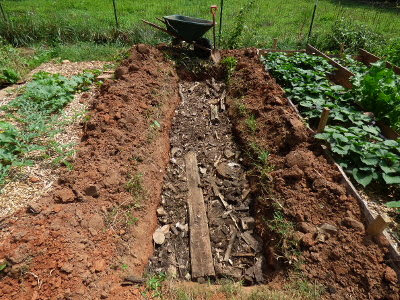
Creating a hugelkultur bed to retain rain runoff.
The tufts of green alongside the bed are wiregrass aka Bermuda.

The top layer is topsoil mixed with compost and mulched with leaves.

Hugelkultur swale bed complete and mulched with leaves.
Those are sweet potatoes in the bed on the right, melons on the left.

The next step will be to build a border around the bed. Over time we'll build the soil up with more mulch and compost. 

And Dan's project? The clay was perfect for the task.
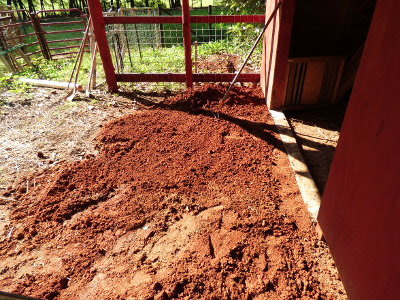
Rehoming the clay to reshape the slope under the goat barn overhang.
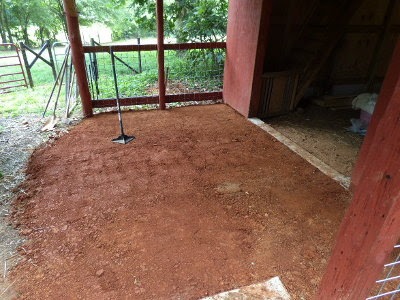
When it's damp, our red clay is easy to form and shape.

Packed red clay under the goat barn overhang.
Packed down it will dry hard and solve several problems.

The clay worked perfectly, and I have to say it's a good feeling to use our own resources. Best of all, we got two important jobs done.